

Roadside Safety Tips for UK Drivers
Table of Contents
- Why Roadside Safety Matters for Every Driver
- What to Do If Your Car Breaks Down on a Motorway
- High Visibility Roadside Safety Equipment You Must Carry
- Emergency Breakdown Kit Checklist
- Defensive Driving to Avoid Breakdowns
- Speed, Weather and Road Conditions
- Vehicle Maintenance Checks Before Long Journeys
- Modern Safety Technology: GPS Beacons and Early Warning Systems
Last Updated: August 17, 2026
Why Roadside Safety Matters for Every Driver
A breakdown on a busy motorway is dangerous. When your vehicle stops on the hard shoulder, you’re vulnerable to high-speed traffic, poor visibility, and the stress of being stranded. Every year, thousands of drivers face breakdowns in conditions where seconds matter. The difference between being seen and invisible to oncoming traffic can mean the difference between a minor inconvenience and a serious collision.
Roadside safety requires more than knowing the rules, it requires the right equipment, mindset, and preparation. A stationary car blends into the background for drivers approaching at 70 mph, especially in poor light or bad weather. That’s why proper roadside safety equipment and awareness are non-negotiable for anyone who drives on motorways regularly.
What to Do If Your Car Breaks Down on a Motorway
When your vehicle loses power or control on a motorway, your immediate actions determine your safety and the safety of other road users.
Immediate actions when you lose power or control
If your engine cuts out or you lose control, stay calm. Switch on your hazard lights immediately, this is your primary warning to other drivers. If still moving, steer gently toward the hard shoulder, keeping both hands on the wheel. Once on the hard shoulder, switch off the engine.
Exit your vehicle only when safe. Open the driver’s door carefully, checking your mirror and blind spot. Get everyone out through doors furthest from traffic, ideally the passenger side. Move to a safe location away from the vehicle, behind the safety barrier if one exists, or at least several metres from the hard shoulder.
Never attempt repairs on the hard shoulder. The risk from passing traffic is too great, especially at night or in adverse weather.
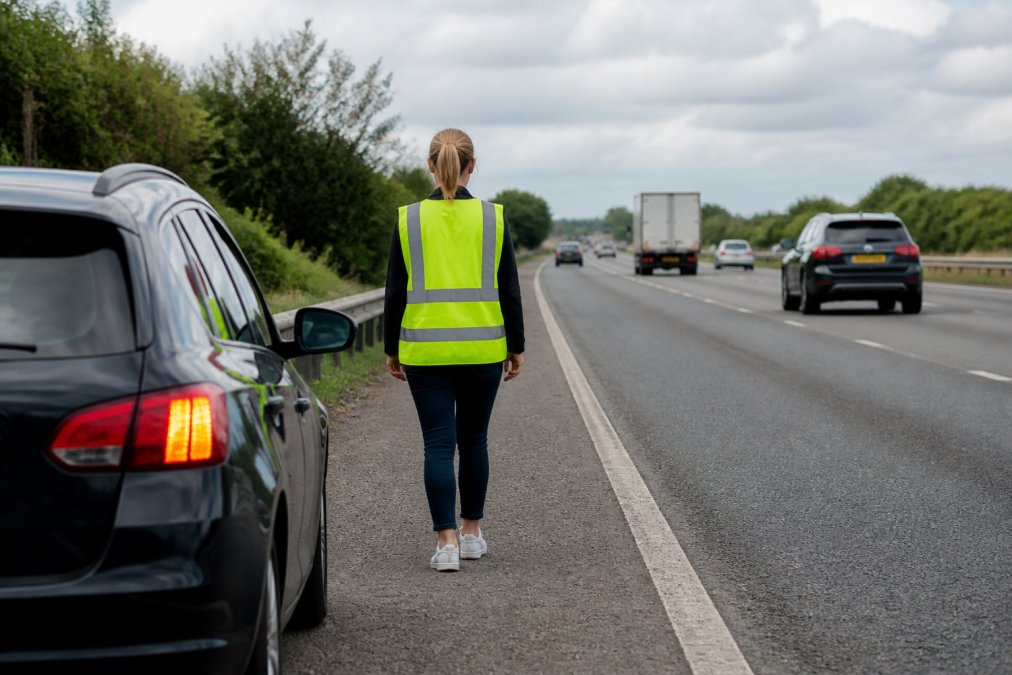
Staying safe while waiting for help
Contact emergency services or a breakdown recovery service immediately. If emergency areas are marked, move to one, they’re specifically designed for breakdowns and offer better protection than the hard shoulder.
Wear your high-visibility vest at all times; it’s a legal requirement and dramatically increases visibility. If dark, use a torch to make yourself visible. A vehicle approaching at 70 mph covers a football pitch in just over two seconds.
Keep your mobile phone charged and ensure you have signal. Stay alert to your surroundings. If you feel unsafe, due to heavy traffic or deteriorating weather, contact emergency services again.
High Visibility Roadside Safety Equipment You Must Carry
Visibility is everything when your vehicle is stationary on a motorway. The Highway Code requires certain items, and understanding why these requirements exist will help you appreciate their importance.
Your vehicle must carry at least one high-visibility vest complying with EN ISO 20471 standard, ideally one for each occupant. A high-visibility vest dramatically increases your visibility to oncoming traffic, particularly at night or in fog. Studies consistently show visibility is the single most important factor in preventing collisions with stationary vehicles.
Warning triangles are a legal requirement. Place at least one on the road at least 45 metres behind your vehicle (about 15 car lengths). This distance gives approaching drivers adequate warning and time to slow down. In poor visibility, fog, heavy rain, or darkness, place the triangle even further back.
Beyond legal minimums, modern roadside safety equipment has evolved significantly. Roadflash’s multi-award-winning early warning systems use GPS and geolocation to alert emergency services to your exact location, while advanced LED lighting systems increase visibility far beyond traditional triangles and vests.
Emergency Breakdown Kit Checklist
A comprehensive breakdown kit goes beyond legal minimums and prepares you for various scenarios.
Start with essentials: a high-visibility vest for each occupant, warning triangles, a torch with spare batteries, and a mobile phone charger or power bank. Add jumper cables or a portable jump starter if confident using them. Include a basic tool kit with wrench, screwdriver set, and pliers. A spare fuse box and serpentine belt are useful if you know how to fit them.
For longer journeys or regular motorway driving, add a first aid kit, blanket or emergency foil blanket, reflective warning vest, water bottle, and high-energy snacks. In winter, add an ice scraper, de-icer, and small shovel. A fire extinguisher is optional but valuable.
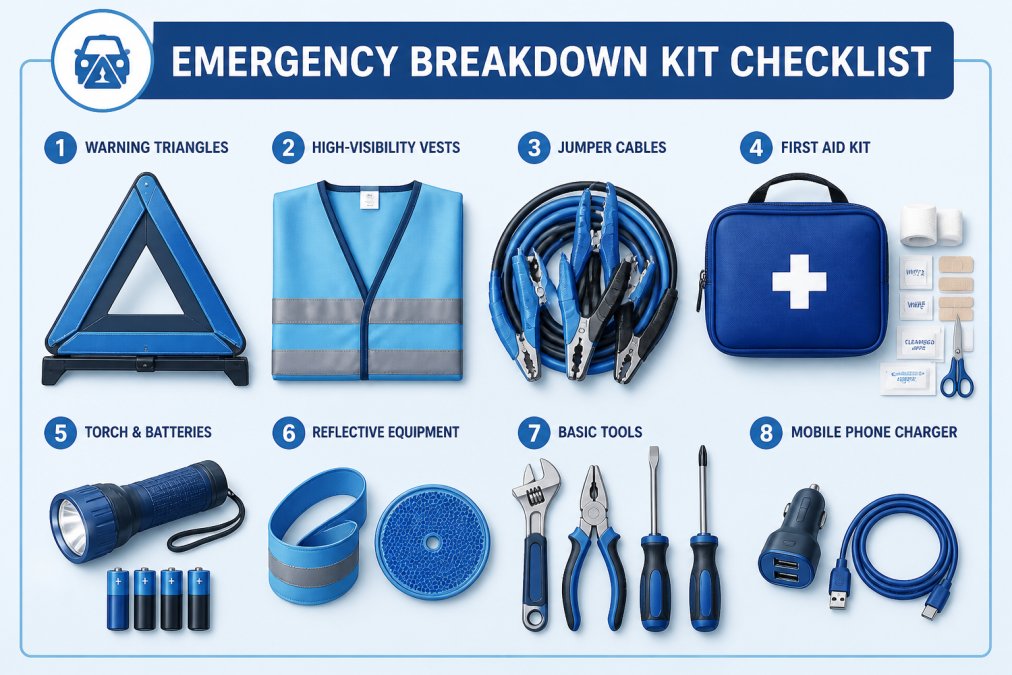
Keep your breakdown kit in a dedicated bag in your boot, easily accessible. Check it regularly, replace batteries, refresh first aid supplies, and ensure nothing has expired.
Defensive Driving to Avoid Breakdowns
The best breakdown is the one that never happens. Defensive driving and regular vehicle maintenance significantly reduce your risk of breaking down on a motorway.
Maintain a safe following distance, at least two seconds behind the vehicle in front, or more in poor visibility. Avoid sudden lane changes, keep a steady speed, and be aware of traffic flow around you. Watch for early warning signs: strange noises, vibrations, handling changes, or dashboard warning lights. Don’t ignore these signs; pull off at the next services or exit and have the vehicle checked.
Smooth driving is important. Harsh acceleration, aggressive braking, and rapid lane changes stress your vehicle’s components. By driving smoothly and predictably, you reduce wear on your engine, transmission, brakes, and suspension.
Speed, Weather and Road Conditions
Your speed must always be appropriate for road conditions, visibility, and traffic flow. The national speed limit on motorways is 70 mph, but this is a maximum, not a target. In poor visibility, fog, heavy rain, snow, or darkness, reduce your speed significantly. You need to stop within the distance you can see ahead.
Adverse weather creates compound hazards. Rain reduces tyre grip and increases braking distances. Fog reduces visibility for you and other drivers. Wind affects steering. Snow and ice transform the motorway into a much more dangerous environment. Increase your following distance to at least four seconds and reduce your speed well below the national limit.
Be aware of the forecast before you travel and adjust your driving accordingly. If conditions are severe, ice on the road, heavy snow, or visibility so poor you can barely see ahead, consider postponing your journey.
At 70 mph in dry conditions, you need roughly 96 metres to stop. In wet conditions, this increases to around 140 metres. On ice, it can exceed 300 metres. This is why speed in poor conditions is so dangerous.
Vehicle Maintenance Checks Before Long Journeys
Before any long journey, particularly on a motorway, perform a basic vehicle check. This takes ten minutes but can prevent serious problems.
Check your tyres first. Tread depth must be at least 1.6 mm across the central three-quarters, but many experts recommend replacing at 3 mm to maintain grip in wet conditions. Check tyre pressure against your vehicle’s specification.
Check your fluids: engine oil, coolant, brake fluid, and windscreen washer fluid. Engine oil should be between minimum and maximum marks. Low oil can lead to engine damage. Coolant prevents overheating. Brake fluid is critical for safe braking. Windscreen washer fluid is important for visibility.
Inspect your lights: headlights, tail lights, brake lights, and indicator lights. Check that wipers work properly. Check your brakes, they should feel firm and responsive. Look at battery terminals to ensure they’re clean and secure. Check that your spare tyre is properly inflated and you have the tools to change a wheel.
Modern Safety Technology: GPS Beacons and Early Warning Systems
Modern roadside safety equipment has evolved far beyond reflective triangles and hazard lights. GPS beacons and advanced warning systems provide layers of protection that traditional equipment cannot match.
A GPS beacon uses satellite positioning to pinpoint your exact location and transmit it to emergency services. This is invaluable if you break down in an area with poor mobile signal or if you’re disoriented. Emergency services can locate you directly without relying on your description or mobile phone triangulation. In fog or darkness on a motorway, knowing your exact location can reduce response times significantly.
Early warning systems use advanced LED technology and reflective surfaces to make your vehicle visible from much greater distances than traditional equipment. Some systems use flashing patterns that draw the eye more effectively than static lights. The most effective systems combine high-visibility lighting with GPS location data.
Roadflash’s multi-award-winning early warning systems are specifically designed for the motorway environment. Their DGT 3.0 compliant emergency beacons combine GPS geolocation with advanced LED lighting to create visibility from significantly greater distances than traditional warning triangles.
Roadside breakdowns are stressful, but they don’t have to be dangerous. By understanding the hazards, carrying the right equipment, and driving defensively, you can significantly reduce both the likelihood of breaking down and the risk if one does occur. Invest in high-visibility roadside safety equipment, maintain your vehicle regularly, and drive according to conditions. When you’re ready to upgrade your roadside safety with modern technology, Roadflash’s GPS-enabled emergency beacons and award-winning early warning systems provide the visibility and location certainty that give drivers genuine peace of mind on every motorway journey. Add to basket and ensure you’re protected.
Frequently Asked Questions
What should you do if your car breaks down on a motorway?
Turn on your hazard lights immediately and move your vehicle to the hard shoulder if it's safe to do so. If you cannot reach the hard shoulder, switch on hazard lights and stay in your vehicle with seatbelts fastened. Put on a high-visibility vest before leaving the car. Stand behind the barrier or away from traffic flow. Call 999 if there's an immediate danger, or the Highways Agency on 0300 123 5000 for roadside assistance. Never stand between your vehicle and oncoming traffic, and avoid working on your vehicle yourself on a busy motorway.
What high-visibility equipment should I keep in my vehicle?
You must carry at least one high-visibility vest compliant with EN ISO 20471 standard. Additionally, keep warning triangles (two are recommended), a torch with spare batteries, and a first aid kit. Consider adding reflective tape, a fire extinguisher, and jump leads. Modern GPS-enabled emergency beacons significantly improve your visibility to other drivers and help emergency services locate you faster during a breakdown, especially in poor visibility or at night.
How do I know my car won't break down on a motorway?
Regular vehicle maintenance is your best defence. Check your tyres for correct pressure and tread depth, ensure your battery is in good condition, and keep fluids topped up. Before long motorway journeys, inspect your vehicle's lights, wipers, and belts. However, even well-maintained vehicles can experience unexpected issues. That's why carrying a comprehensive breakdown kit and having access to modern early warning systems, such as GPS beacons, provides essential backup protection for you and other road users.
Is it safer to stay in my car during a breakdown?
It depends on your location and traffic conditions. On a busy motorway, it's generally safer to exit your vehicle, put on a high-visibility vest, and stand well away from traffic, behind the barrier or on the verge. However, if you cannot safely exit (for example, on a fast dual carriageway with no hard shoulder), remain inside with seatbelts fastened and hazard lights on. Never attempt repairs on a live motorway. Modern GPS-enabled emergency beacons help rescuers locate you quickly, reducing your time in a vulnerable position.
This article was written using GrandRanker