

Signs of Car Trouble Before a Motorway Breakdown
Table of Contents
- Why Recognising Early Signs of Car Trouble Matters
- Dashboard Warning Lights and What They Mean
- Unusual Engine Noises and What They Signal
- Loss of Power and Performance Changes
- Pre-Drive Car Checks to Prevent Breakdown Risk
- What to Do If Your Car Breaks Down on a Motorway
- Roadside Breakdown Safety Equipment You Need
- Conclusion
- Frequently Asked Questions
Last Updated: October 12, 2026
Why Recognising Early Signs of Car Trouble Matters
Spotting signs of car trouble before a motorway breakdown can save your life. A high-speed failure exposes you to fast-moving traffic with limited time to react.
Early warning signs give you options: exit at the next junction, pull into services, or call for help before things get worse.
Most drivers ignore the first signals their car sends, a flickering dashboard light, an unusual noise, a slightly different engine feel. These warn you before failure happens.
Preventive awareness reduces breakdowns on busy roads. This guide covers what to watch for, what each warning means, and what to do when trouble starts.
Dashboard Warning Lights and What They Mean
Warning lights are your car’s earliest written message. The colour sets urgency; the symbol identifies the system. Read both together.
The severity framework: red, amber, green
- Red, stop as soon as it is safe to do so. Do not continue to the next junction if the car is still moving safely; pull into the nearest safe place.
- Amber, a fault is stored. You can usually continue, but book a diagnostic check and avoid starting a long motorway journey until it is investigated.
- Green or blue, information only (lights on, cruise control active). No action needed beyond normal driving.
Symptom-to-likely-cause guide
Use this table to connect symptoms to likely causes. It is a guide, not a diagnosis, only a garage scan confirms a fault code.
| What you notice | Light or sign | Likely cause | Urgency |
|---|---|---|---|
| Engine misfiring, rough idle, loss of power | Flashing amber engine management light | Misfire, ignition or fuelling fault | Stop safely, do not continue |
| Steady amber engine light, car drives normally | Amber engine management light | Emissions or sensor fault | Book diagnostic soon |
| Oil can symbol, engine rattling | Red oil pressure light | Low oil level or oil pump fault | Stop immediately, engine damage risk |
| Temperature gauge climbing, steam from bonnet | Red coolant temperature light | Coolant loss, failed thermostat or water pump | Stop safely, let it cool |
| Battery symbol stays on after start | Amber battery/charging light | Alternator or drive belt fault | Check charging system before next long trip |
| Tyre symbol, slight pull to one side | Amber tyre pressure light | Slow puncture or pressure loss | Check pressures at next services |
| Brake symbol with (!) | Red brake warning light | Low fluid, worn pads, or system fault | Stop safely, do not continue |
| ABS symbol while braking | Amber ABS light | Wheel sensor or ABS fault | Normal braking remains, but get it checked |
| Glow plug symbol (diesel) stays on | Amber pre-heat light | Glow plug or relay fault | Hard starting likely; book a check |
| Traction control light flashing | Amber stability light | Wheel slip or system intervention | Ease off; if it stays on, get it checked |
A flashing red light is always more urgent than a steady one. If a red light flashes, treat it as a stop-now signal rather than a drive-to-the-garage signal.
What to do the moment a light appears at motorway speed
- Keep both hands on the wheel and maintain steady speed. Do not brake sharply or swerve.
- Check your mirrors and blind spot. Identify the next exit, services, or emergency area.
- Indicate early and move left one lane at a time.
- If the light is red and the car is still driveable, leave at the next junction or services. Do not stop in a live lane.
- If the car loses power or steering assistance, use hazard lights and coast to the hard shoulder or an emergency area.
- Switch off the engine once stationary and call for assistance.
Petrol, diesel, hybrid and electric differences
- Petrol, the engine management light is the most common early warning; misfires often appear first as a slight hesitation under acceleration.
- Diesel, the diesel particulate filter (DPF) warning light means a regeneration cycle is needed. A steady light usually clears after a sustained motorway run; a flashing light means the filter is overloaded and needs a garage visit.
- Hybrid, a high-voltage system warning (often an orange battery symbol with an exclamation mark) means the hybrid system has a fault. The car may still run on the petrol engine, but do not ignore it.
- Electric, a red high-voltage battery warning means stop safely and do not attempt to continue. A turtle or reduced-power symbol means the battery is limiting output; find a charge point or safe place immediately.
Colour sets the urgency; the symbol tells you the system. If you are unsure, treat any red light as a stop signal and any flashing light as more urgent than a steady one.
Unusual Engine Noises and What They Signal
Strange engine sounds often appear before any warning light, your ears can detect trouble earlier than your dashboard.
A knocking sound under acceleration suggests engine detonation, fuel isn’t burning properly and can damage the engine.
A grinding noise on start-up means the starter motor is struggling and may fail soon.
A squeal when steering or accelerating often points to a worn serpentine belt, which drives your alternator and power steering.
A hissing sound under the bonnet suggests a coolant leak and rising engine temperature.
A clunk over bumps may indicate suspension damage or loose components, affecting handling and stability.
Loss of Power and Performance Changes
Gradual power loss gives you time to react; sudden power loss puts you in danger.
A gradual drop in power often means fuel system problems, a clogged air filter, or developing engine issues. Reduce speed and exit at the next junction.
Sudden power loss is more serious, the engine may cut out.
Hesitation or stuttering under acceleration suggests misfiring, usually an ignition or fuel system fault.
Difficulty maintaining speed on slight inclines means the engine is working harder than it should, often from a fuel filter blockage or transmission issue.
Pre-Drive Car Checks to Prevent Breakdown Risk
Essential checks before every motorway journey
These checks take ten minutes and prevent most breakdowns. Do them before every motorway trip.
Check your oil level. Pull the dipstick, wipe it clean, reinsert it fully, then pull it out again.
Check your coolant level. The coolant reservoir is usually a translucent plastic tank.
Examine your wipers. They should clear the windscreen without streaking; replace them if they leave marks or skip.
Look under the car for leaks. Park on a light surface and check for drips.
Test your brakes before leaving home. Drive slowly and brake gently; the pedal should feel firm.
What to Do If Your Car Breaks Down on a Motorway
The safe-stop hierarchy
Aim for the highest option you can reach safely:
- Motorway services, safest: off the carriageway, lit, staffed.
- Next junction exit, leave the motorway and stop on a side road or safe lay-by.
- Emergency area, a marked lay-by or, on smart motorways, a refuge with an orange SOS phone.
- Hard shoulder, only if one exists and you cannot reach the above. Stop as far left as possible.
- Live lane, last resort. If the car cannot move, keep hazard lights and seatbelts on and call 999 immediately.
On a smart motorway, the hard shoulder may be a live lane (National Highways delivers smart motorway safety upgrade). Never assume it is safe to stop there. Look for the red X above the lane and the emergency area signs.
Immediate safety steps
- Hazard lights on immediately, before steering.
- Steer smoothly left. Do not brake hard; use gentle pressure and signal.
- Stop as far left as possible, at least one metre from the live lane.
- Turn off the engine to reduce fire risk.
- Keep your seatbelt on until you decide whether to exit.
- Leave the car only if safe. Exit on the left away from traffic and stand behind the barrier; otherwise stay inside with doors locked.
Signalling and being seen
- Hazard lights stay on throughout the stop.
- High-visibility jacket, put it on before leaving the vehicle. Not a legal requirement in a car, but strongly recommended and required in many commercial vehicles.
- Warning triangle, the Highway Code advises against using one on a motorway. Use it only on other roads where safe and visible.
- SOS phone, on the hard shoulder or in an emergency area, use the orange SOS phone rather than your mobile if you can; it connects directly to the control centre, which knows your exact location. On a mobile, give the marker post number (for example, “M1 northbound, marker post 45.3”).
- Breakdown cover, call your provider once safe. Give the motorway, direction, junction or marker post, and your vehicle details.
What not to do
- Do not attempt repairs on the hard shoulder or in a live lane.
- Do not stand between your car and oncoming traffic.
- Do not walk along the carriageway to find a marker post, use the SOS phone or your mobile from a safe position.
- Do not open the bonnet if you see or smell smoke; wait for assistance.
Services first, exit second, emergency area third, hard shoulder fourth. If you cannot reach any of them, stay in the car with hazards on and call 999.
Roadside Breakdown Safety Equipment You Need
The right equipment transforms a breakdown from dangerous to manageable.
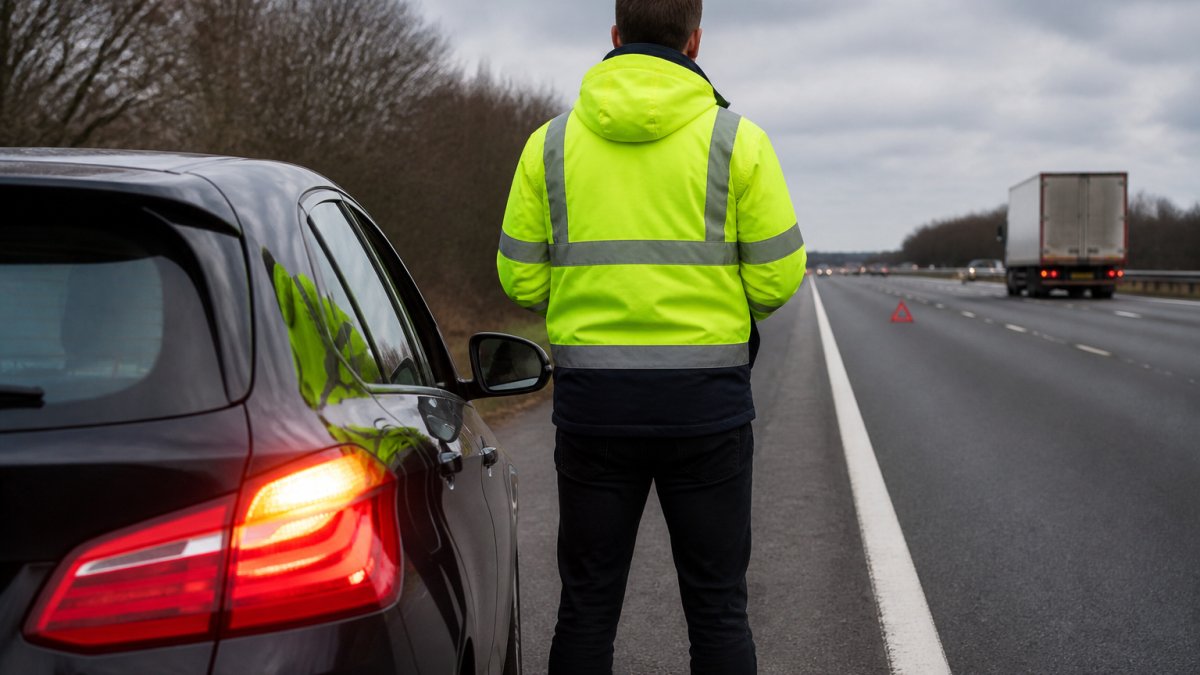
A high-visibility jacket is strongly recommended whenever you exit your vehicle on a motorway, other drivers need to see you immediately.
A warning triangle or emergency beacon alerts traffic to your presence. Modern beacons with flashing lights are far more visible than triangles in poor light or rain.
A torch helps you see under the bonnet and signals to other drivers. A headtorch leaves your hands free.
A basic tool kit allows minor adjustments.
A phone charger ensures you can call for help; a portable power bank works even if the car’s charging isn’t.
Conclusion
Recognising signs of car trouble before a motorway breakdown gives you time to react safely. Warning lights, unusual noises, and performance changes tell you something needs attention, and pre-drive checks take minutes but prevent most breakdowns.
When trouble happens, the right safety equipment makes all the difference. Roadflash emergency beacons combine high-visibility flashing lights with GPS geolocation, so you’re visible to other traffic and emergency services know exactly where to find you. Add to basket and drive with confidence knowing you’re prepared for whatever the road brings.
Frequently Asked Questions
What are the most important warning signs that a car is about to break down?
The most critical signs include a flashing red engine warning light, a sudden loss of power or acceleration, unusual grinding or knocking noises from the engine, a burning smell, steam from under the bonnet, or a significant drop in oil pressure or coolant temperature shown on your dashboard. Any of these warrant pulling over safely and stopping driving immediately. Ignoring them risks engine damage or a complete breakdown on a busy motorway.
Which dashboard warning lights mean I should stop driving immediately?
Red warning lights demand immediate action: a flashing engine fault light, oil pressure warning, coolant temperature warning, and brake system warning all indicate serious faults. Stop driving as soon as safely possible and switch off the engine. Amber or yellow lights typically indicate less urgent issues that need attention soon but allow you to continue driving carefully to a safe location or garage. Always consult your vehicle handbook to confirm what each light means for your specific car.
How can I check my car before a motorway journey to reduce breakdown risk?
Perform a pre-drive check covering battery terminals for corrosion, oil and coolant levels, tyre condition and pressure, lights and wipers, brake fluid level, and fuel quantity. Check that all warning lights extinguish after starting the engine. Listen for unusual noises during a short test drive. If your car has been unused for several days, allow the engine to warm up briefly before joining the motorway. These simple checks catch many potential faults before they cause a breakdown at speed.
What should I do immediately if my car shows warning signs while driving on a motorway?
Stay calm and reduce speed gradually. Switch on your hazard warning lights to alert other drivers. Move to the left lane, then the hard shoulder, and stop in a safe location away from moving traffic. Switch off the engine and turn on your hazard lights. Put on a high-visibility jacket. If you have roadside breakdown safety equipment such as a warning triangle or LED beacon, deploy it behind your vehicle at a safe distance to warn approaching traffic. Call for roadside assistance and remain inside your vehicle with doors locked until help arrives.