
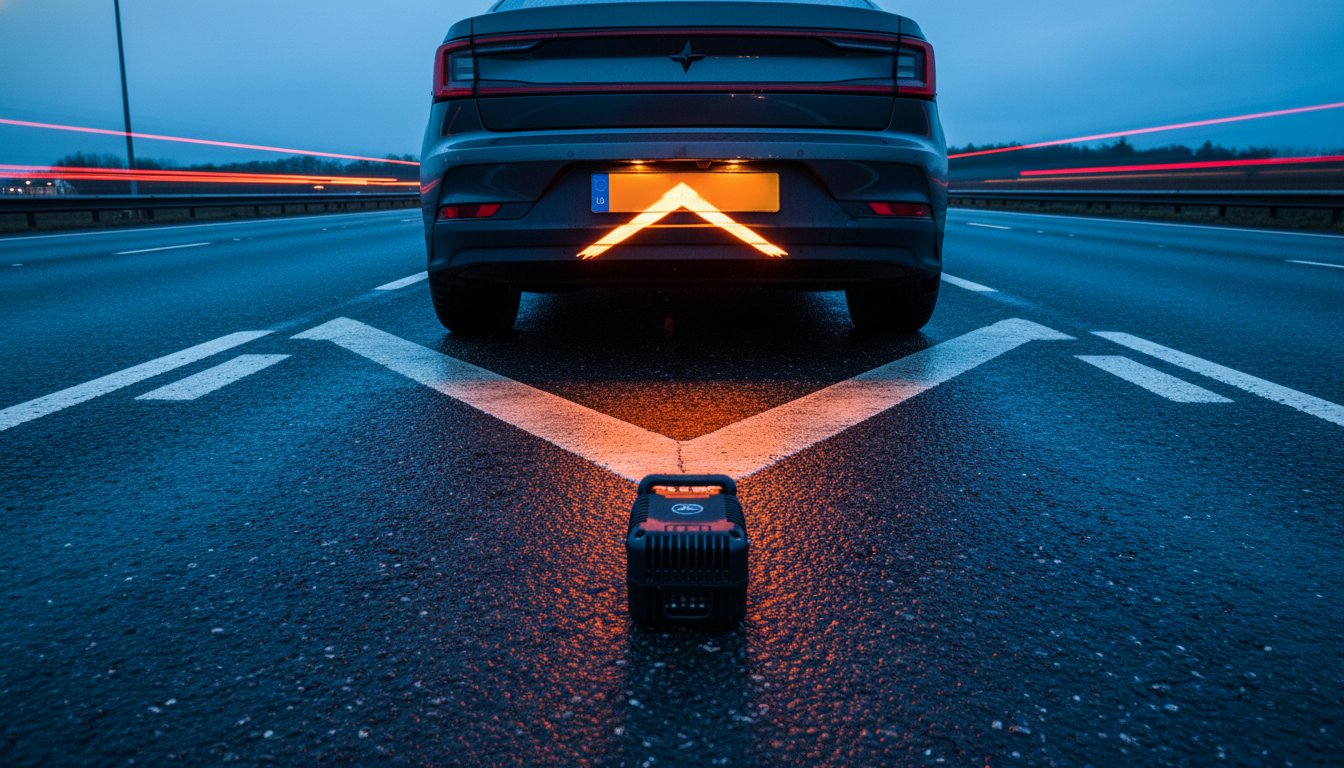
High-Speed Collision Prevention: 5 Dangerous Myths Debunked for 2026
What if the sophisticated safety sensors in your modern vehicle are actually creating a dangerous sense of false security when you’re stranded on a high-speed motorway? Whilst it’s reassuring to see 45 vehicles earn the IIHS TOP SAFETY PICK+ award in 2026, these systems are primarily designed for moving traffic rather than protecting a stationary car. Relying solely on internal tech for high-speed collision prevention is a risk that ignores the harsh reality of over 11,000 speeding-related fatalities recorded in 2024. You likely feel that your hazard lights and on-board cameras provide a sufficient safety net, yet these tools often vanish in the glare of night-time traffic or high-speed approach angles.
This article promises to reveal why standard safety features fall short during breakdown emergencies and how professional visibility hardware from the Roadflash shop saves lives. We will debunk five dangerous myths that persist in 2026, including the hazard light fallacy and the limits of automated braking. By the end, you’ll understand how to create a robust safety perimeter using the specialist inventory at www.roadflash.co.uk to ensure your vehicle is visible long before a driver needs to react. Our goal is to provide you with the knowledge and tools required to manage roadside risks with calm confidence and professional-grade protection.
Key Takeaways
- Identify the critical limitations of modern Automatic Emergency Braking (AEB) and why software alone cannot protect a stationary vehicle on a motorway.
- Understand the science of the “Moth Effect” and why standard hazard lights often fail to provide the necessary conspicuity for oncoming drivers at high speeds.
- Master the principles of high-speed collision prevention by establishing an active safety perimeter that physically directs traffic away from your position.
- Discover how to utilise professional visibility hardware from the Roadflash shop to bridge the gap between vehicle tech and physical roadside safety.
- Explore the full range of safety solutions at www.roadflash.co.uk, including the Folding LED Arrow Light and specialised hazard awareness equipment.
The Myth of the Automated Safety Net: Why In-Car Tech is Insufficient
In the context of motorway safety, high-speed collision prevention is the proactive reduction of secondary impact risks on major roads. It involves creating a visible barrier that alerts drivers long before their vehicle’s software needs to intervene. Many motorists believe that their modern car’s collision avoidance system will automatically prevent a crash if they break down. This is a dangerous misconception. Software-based collision assist functions as a secondary line of defence; it’s a last-resort measure that cannot replace the primary necessity of being physically visible to the human eye.
The Problem with Passive Reliance
AEB systems are engineered with specific speed and distance thresholds that vary significantly amongst manufacturers. On a motorway, where vehicles travel at 70mph, the “reaction gap” is substantial. This is the distance a car covers in the milliseconds it takes for the sensors to identify a stationary hazard and for the brakes to engage. Often, these systems are optimised for urban environments and may not react in time to avoid an impact whilst your vehicle is stationary. Relying on passive tech ignores the reality that high-speed collision prevention requires more than just internal logic.
Environmental Factors That Blind Sensors
External conditions such as heavy rain, road spray, and low-light levels frequently compromise on-board tech. Radar and cameras can become blinded by glare or obscured by moisture, making it impossible for the car to detect a hazard ahead. To bridge this gap, drivers must look toward professional-grade hardware found at the Roadflash shop. Integrating high-intensity emergency breakdown lights from the inventory at www.roadflash.co.uk ensures that your vehicle is a beacon of light, cutting through environmental interference that would otherwise baffle a car’s internal sensors. Consider how these factors impact sensor performance:
- Reflective Glare: Wet road surfaces can bounce light in ways that confuse optical sensors.
- Particle Density: Heavy fog or spray creates a physical barrier that radar may not penetrate effectively.
- Contrast Loss: Low-light conditions make it difficult for cameras to distinguish a dark vehicle from the asphalt.

The Hazard Light Fallacy: The Science of High-Speed Conspicuity
Standard hazard lights are often the first thing a driver activates during a roadside emergency. Whilst they serve a purpose in slow-moving urban traffic, they are frequently inadequate for high-speed collision prevention on motorways. At 70mph, a vehicle covers roughly 31 metres every second. This leaves oncoming drivers with a dangerously narrow window to identify a stationary hazard amongst the visual clutter of a busy road. Relying on factory-fitted indicators assumes that other motorists are paying full attention and can accurately judge your position in the dark or during heavy rain.
A more sinister risk is the “Moth Effect”, where drivers subconsciously steer towards uniform, flashing lights. This psychological phenomenon can turn a safety signal into a beacon that inadvertently attracts a collision. To counter this, high-intensity LEDs are essential to cut through the glare of other headlights and environmental spray. These tools provide the conspicuity required to be seen from a distance that software cannot always manage, especially given the documented limitations of crash avoidance technologies in complex roadside scenarios.
Understanding Human Reaction Times
The distance required to perceive, process, and react to a hazard at motorway speeds is often underestimated. By the time a driver realises a car is stationary, they may already be too close to safely change lanes without aggressive braking. Deploying an LED arrow light for vehicles provides a clear, unmistakable visual cue. This hardware allows other motorists to begin their manoeuvre hundreds of metres earlier, which is vital for high-speed collision prevention.
The Role of Directional Warning
Directional lighting is far more effective than a simple “danger” signal. Sequential lighting patterns influence oncoming driver behaviour by providing a specific instruction to move over rather than just highlighting a problem. This proactive approach transforms a passive breakdown into a managed safety zone. You can explore the full range of directional hardware and visibility tools at the Roadflash shop to better protect your vehicle during an emergency.
Proactive Prevention: Securing Your Perimeter with Roadflash Technology
The Roadflash shop serves as the definitive central hub for professional-grade safety hardware in the UK. Whilst vehicle software provides a necessary secondary layer of protection, the primary objective of high-speed collision prevention is to ensure your vehicle is never a surprise to oncoming traffic. Achieving this requires a shift from passive hazard lights to active, high-intensity hardware that defines a clear safety perimeter. By establishing this zone, you provide other motorists with the time and visual cues they need to react safely at motorway speeds.
The Roadflash Safety Ecosystem
The Folding LED Arrow Light is a cornerstone of this proactive approach. It combines portability with professional-grade intensity, allowing motorists to project a clear directional signal that commands attention from hundreds of metres away. When paired with the Hazard Awareness Road Fan, which provides 360-degree visibility, the risk of sensor blindness or human error is drastically reduced. For those operating in specific regions or looking towards the future of road safety, the V16 Emergency Beacon DGT 3.0 offers geolocation-enabled safety, representing the forward-thinking nature of 2026 safety standards.
Adding a Road Safety Traffic Cone with Light further enhances this setup by creating a physical and visual barrier. This multi-layered strategy ensures that even if one element is obscured by road spray or glare, the overall safety zone remains intact. The breadth of inventory available at www.roadflash.co.uk allows every driver to customise their safety kit to their specific vehicle and driving habits.
Implementing a “Zero-Impact” Strategy
A “zero-impact” strategy relies on organising your safety gear before a breakdown occurs. Motorists and fleet managers should ensure that hardware like the Hazard Awareness Safety Light or the Hazard Awareness Wrap is easily accessible in the vehicle. To maximise the effectiveness of your equipment when it matters most, following a structured approach to roadside safety hardware longevity ensures that every component performs reliably under the harshest conditions. When deploying Roadflash hardware, always prioritise personal safety by remaining behind the crash barrier whilst positioning lights and cones to guide traffic away from the site. This methodical approach ensures that you aren’t just reacting to a hazard, but actively managing it.
A multi-layered approach involving lights, cones, and beacons is the gold standard for high-speed collision prevention. It transforms a vulnerable stationary vehicle into a managed, highly visible hazard that is impossible to ignore. We invite you to browse the full range of hazard awareness hardware at the Roadflash shop to secure your perimeter today.
Prioritising Your Safety with Professional Visibility
The landscape of motorway safety is evolving, yet the fundamental requirement for visibility remains constant. We have explored why internal software cannot always bridge the gap during a roadside emergency and why standard hazard lights often fail to provide necessary conspicuity. True high-speed collision prevention requires a shift from passive reliance to active management of your vehicle’s safety perimeter. By integrating durable, high-intensity LED technology into your breakdown protocol, you ensure that your presence is communicated clearly to every oncoming driver long before software needs to intervene.
Roadflash stands as a dedicated specialist team of UK-based road safety experts. Our products are trusted by fleet operators and private motorists nationwide for their reliability in high-stakes scenarios. We invite you to Explore the Full Roadflash Inventory for Professional Safety Hardware to find the sophisticated solutions your vehicle requires. Equipping yourself with professional hardware is a vital investment in your protection, allowing you to face any roadside challenge with calm confidence and a proactive mindset.
Frequently Asked Questions
Is automatic emergency braking enough to prevent a high-speed collision?
No, automatic emergency braking (AEB) is not a sufficient standalone solution for high-speed collision prevention. These systems are designed as a secondary line of defence and often have operational limits when dealing with stationary objects at motorway speeds. Environmental factors such as heavy rain or low-light conditions can also blind the sensors, making it essential to use active visibility hardware to alert human drivers long before software needs to intervene.
Why are LED arrow lights more effective than standard hazard lights?
LED arrow lights provide a clear directional instruction that tells oncoming drivers exactly where to move, whereas standard hazard lights only signal a general presence of danger. At 70mph, removing ambiguity is vital for safety. The high-intensity LEDs available in the Roadflash shop are engineered to cut through visual clutter and road spray, providing a much higher level of conspicuity than factory-fitted vehicle indicators can achieve alone.
How far behind my vehicle should I place emergency lighting?
You should place emergency lighting at a distance that provides oncoming drivers with at least ten seconds of reaction time. At motorway speeds, this means positioning hardware like the Hazard Warning Breakdown Light or a Road Safety Traffic Cone with Light roughly 100 metres behind your stationary vehicle. This creates a managed safety perimeter that allows traffic to begin lane changes well in advance of reaching your position.
What is the “moth effect” in road safety and how can I avoid it?
The “moth effect” is a dangerous phenomenon where drivers subconsciously steer towards a uniform flashing light, potentially leading to a collision with a stationary vehicle. You can avoid this by utilising directional lighting that provides a sequential “move over” cue. Products like the Folding LED Arrow Light at www.roadflash.co.uk are designed to guide traffic away from your vehicle, effectively breaking the psychological pull of a static hazard light.