
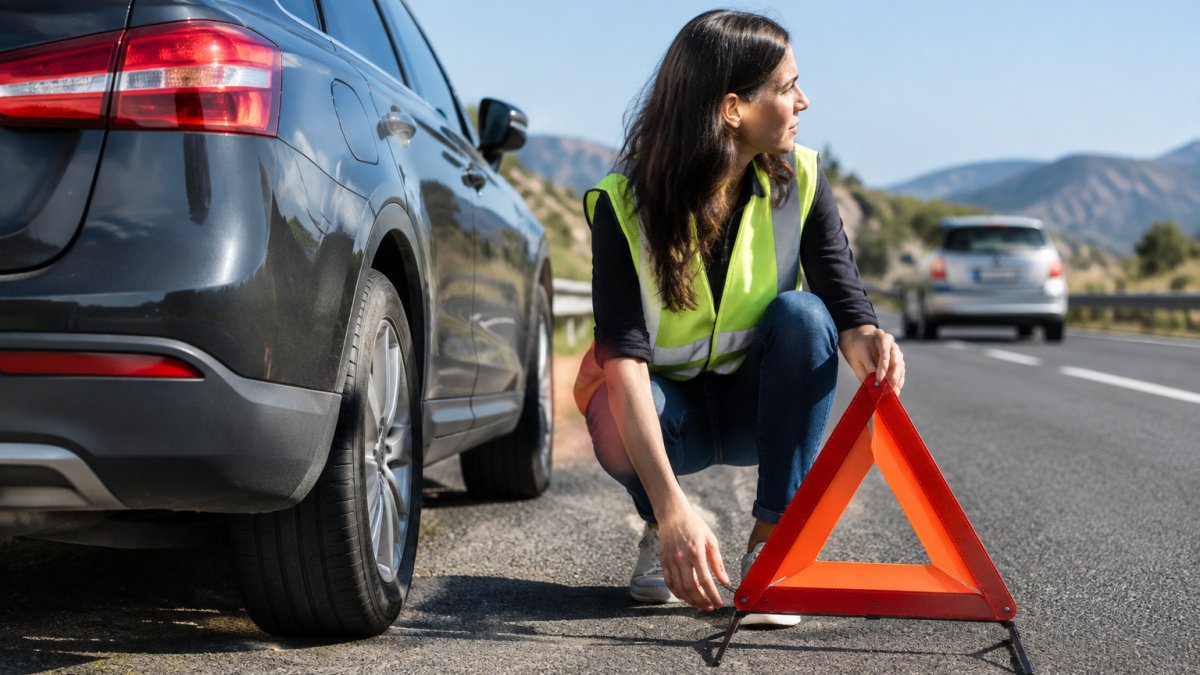
Do UK Tourists Need a Beacon in Spain?
Last Updated: November 22, 2026
Quick Summary
Spain roadside assistance for UK tourists starts with three things: a DGT 3.0 compliant beacon in the vehicle, a high-visibility vest for each occupant, and the right phone number to call. For injuries, fire or a hazard in a live lane, call 112; for a routine breakdown, call your breakdown provider or the hire company.
- Check the current DGT official website before travelling, as requirements have been adjusted in recent years.
- Carry a high-visibility reflective vest for each occupant and put yours on before leaving the vehicle.
- Call the hire company first for a rental car, and do not authorise a private tow without clearing it with them.
- Give your road number, kilometre marker and direction of travel, since Spanish roads are located by these rather than street address.
- Keep your passport, licence, registration document and insurance certificate together in one folder for roadside checks.
Table of Contents
- Spain Roadside Assistance Rules for Tourists: The Essentials
- Is a DGT 3.0 Beacon Mandatory in Spain?
- Using UK Breakdown Cover in Spain
- What to Do If Your Car Breaks Down in Spain
- Step 1: Secure the vehicle before you do anything else
- Step 2: Get your vest on before you open the door
- Step 3: Place the beacon, then get behind the barrier
- Step 4: Decide who to call, and in what order
- Step 5: Give a location that actually helps
- Step 6: Wait safely, and know what help looks like
- Useful phrases for the call
- The Spain Roadside Assistance Number and When to Call 112
- Required Documents and Vehicle Equipment for Driving in Spain
- Booking Your Beacon and Breakdown Cover Before You Travel
- Frequently Asked Questions
Spain Roadside Assistance Rules for Tourists: The Essentials
Breaking down on a Spanish motorway is stressful enough without wondering whether you’re breaking the law. Most UK drivers arrive with a valid licence, a car in good order and a reasonable idea of what to do. The gap usually appears at the roadside, when the first question is what to put on the road and who to call. Roadflash, a Nottingham-based maker of early warning systems for stationary vehicles, has built its products around exactly that moment.
The essentials are simpler than the forums suggest. Know the emergency number, know where your warning equipment lives in the boot, and know which documents you must carry. Getting those three things right covers most situations a tourist will face.
Is a DGT 3.0 Beacon Mandatory in Spain?
The Dirección General de Tráfico (DGT) has moved the warning requirement away from the traditional warning triangle and towards a connected emergency beacon, commonly called a DGT 3.0 device. The change matters to tourists because the rule is about what you carry in the vehicle, not what you can buy at a service station after something goes wrong. Check the current position on the DGT official website before you travel, because the detailed requirements and any transitional arrangements have been adjusted more than once in recent years.
What the device actually does
A compliant beacon is designed to be visible to approaching traffic from a distance and to signal the vehicle’s position. The device should be a recognised DGT 3.0 model, charged or powered as the manufacturer specifies, and stored where it can be reached easily.
Triangles, vests and the rest of the kit
The beacon does not replace every other item. Carry a high-visibility reflective vest for each occupant, and put yours on before leaving the vehicle. Keep the whole kit together so that, in the dark or in rain, you are not searching through the boot.
What happens if you are stopped without one
Police can ask to see both your documents and your safety equipment at roadside checks. Without a compliant beacon you are less visible at the moment you are most vulnerable. Do not assume that a hire car is automatically equipped to the current standard, check the glovebox and boot before you drive away, and if the device is missing or uncharged, raise it with the rental desk before leaving the depot.
Requirements in this area can change, so verify any device against the DGT’s current guidance rather than relying on an old purchase.
Using UK Breakdown Cover in Spain
Breakdown policies vary in the help they offer abroad. Read the small print before you leave. Our European breakdown cover guide comparing single-trip and annual options shows how the two types differ for a trip like yours.
A common mistake is assuming a UK policy will cover everything. Check whether it covers hire cars, how long you can stay abroad, and what the assistance phone line costs to call. Keep your policy number and the assistance number saved on your phone and written on paper.
What to Do If Your Car Breaks Down in Spain
Most guides give you a list. What follows is an ordered response plan built around the decisions a tourist actually has to make, because the wrong first move, such as stepping into live traffic or authorising a recovery you did not need, is what turns a breakdown into an expensive afternoon.
Step 1: Secure the vehicle before you do anything else
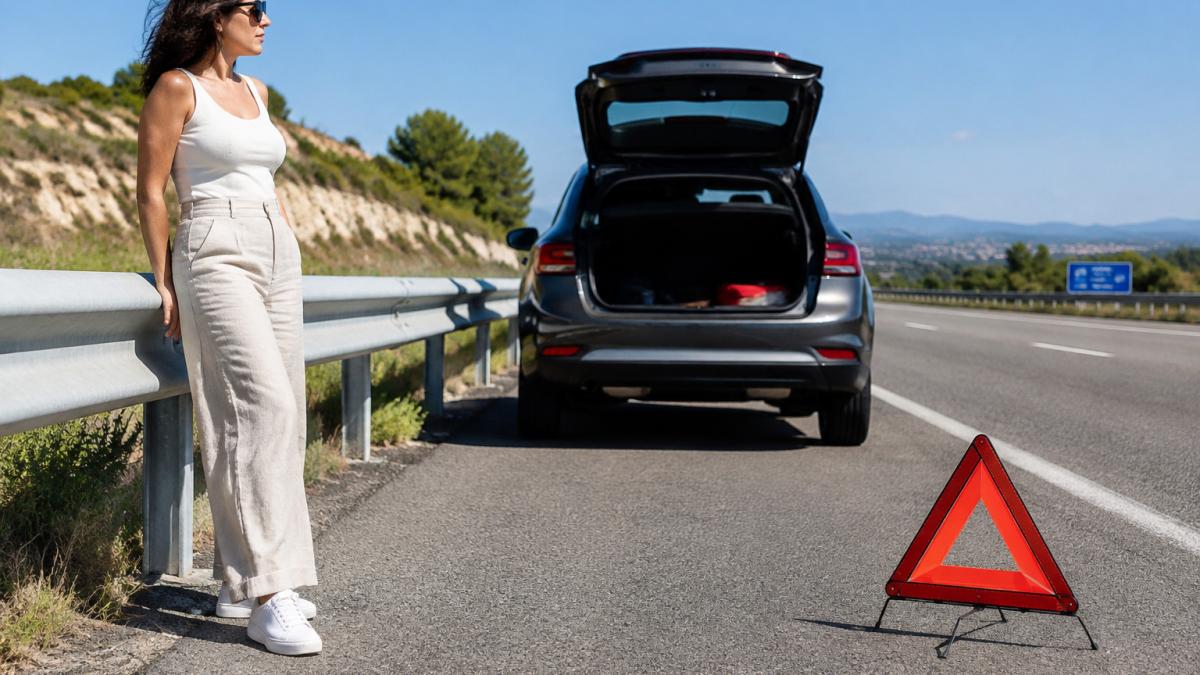
If the car is still moving, ease it as far left as you safely can, onto the hard shoulder on a motorway, or as far onto the verge as the road allows elsewhere. Switch on the hazard lights immediately. If you are in a live lane and the car will not move, do not stand behind it; get yourself and your passengers out on the side away from traffic and behind the crash barrier before you think about warning devices. Once everyone is safely behind the barrier, keep clear of the carriageway and follow the same precautions if a rental car breaks down, with 1st Choice Rentals as a related point of reference.
Step 2: Get your vest on before you open the door
Put on your high-visibility vest before stepping out. On a motorway, keep the vest within reach of the driver’s seat so you are not rummaging in the boot while traffic passes.
Step 3: Place the beacon, then get behind the barrier
Place your DGT 3.0 beacon on the road behind the vehicle at the distance the manufacturer specifies, then move behind the crash barrier. Do not stand between your car and oncoming traffic to wave anyone down. If you are on a rural road with no barrier, stand well off the carriageway on the verge, on the side away from traffic.
Step 4: Decide who to call, and in what order
This is where the plan splits by vehicle type.
- Rental car: call the hire company’s roadside line first. The rental agreement will usually name a recovery provider, and going through the rental company protects your position on the excess and on any replacement vehicle. Do not authorise a private tow or repair you have not cleared with the rental company, you may end up paying for it yourself.
- Own car with UK breakdown cover: call your provider’s European assistance line. Have your policy number ready and confirm whether they will arrange recovery directly or reimburse you.
- Injury, fire, or a vehicle stranded in a live lane: call 112. This is the single European emergency number and it works from any phone. For a routine breakdown with no injuries, your provider is usually the faster route to a tow.
Step 5: Give a location that actually helps
Spanish roads are located by road number and kilometre marker, not by street address. On a motorway, use the emergency telephones along the hard shoulder where they exist, as they connect to an operator. If you are calling from a mobile, read out the road number (for example the AP-7 or the A-4), the kilometre marker on the nearest post, and the direction you are travelling. On rural roads and on the islands, markers are sparser, so describe the nearest town or junction and any distinctive landmark. Sharing a live location pin from your phone is useful, but treat it as a supplement to the road number and kilometre marker, not a replacement.
Step 6: Wait safely, and know what help looks like
Stay behind the barrier or well off the carriageway until assistance arrives. Keep passengers, and especially children, away from the traffic side of the vehicle. Legitimate recovery operators will not ask you to step into a live lane. If someone stops offering unsolicited help and asks for payment up front, decline and wait for your provider or the emergency services.
Useful phrases for the call
You do not need fluent Spanish, but a few phrases speed things up: “Mi coche se ha averiado” (my car has broken down), “Estoy en el kilómetro…” (I am at kilometre…), “No hay heridos” (there are no injuries), and “Necesito una grúa” (I need a tow truck). Say the road number and kilometre marker first, those are the details the operator needs before anything else.
Check with the hire company before authorising a recovery on a rental car, as the rental agreement governs who pays.
The article sets out a six-step response plan, and the table below condenses the key actions and timings.
| Step | What to do | Timing or detail |
|---|---|---|
| Secure the vehicle | Ease onto the hard shoulder and switch on hazard lights | Immediately |
| Put on your vest | Wear your high-visibility vest before leaving the vehicle | Before opening the door |
| Place the beacon | Position the DGT 3.0 beacon behind the vehicle, then move behind the barrier | At the manufacturer’s specified distance |
| Choose who to call | Rental car: hire company first; own car: UK breakdown provider; injuries or fire: 112 | Depends on vehicle and situation |
| Give your location | Read out road number, kilometre marker and direction of travel | Use road number, not street address |
| Wait safely | Stay behind the barrier or off the carriageway, away from traffic | Until assistance arrives |
The Spain Roadside Assistance Number and When to Call 112
For any emergency involving injury, fire or a serious hazard on the road, call 112, the European emergency number, which works from any phone in Spain (Press corner). For a routine breakdown with no injuries, call your breakdown provider instead, as they can arrange a tow and keep you informed.
Give the operator the exact location, the number of people in the vehicle, and any injuries. Speak clearly, even if you find it hard to explain in Spanish. Useful phrase: “Mi coche se ha averiado” means “my car has broken down.”
Required Documents and Vehicle Equipment for Driving in Spain
Carry your full UK driving licence, your vehicle registration document, your insurance certificate and your passport, along with the safety equipment required for Spanish roads.
Keep the documents together in one folder. Police may ask for them at roadside checks, and drink-driving and speeding rules are strictly enforced, so do not drive after drinking alcohol.
Booking Your Beacon and Breakdown Cover Before You Travel
Sort your equipment and cover before the journey, not at the roadside. Consider a DGT 3.0 compliant beacon from Roadflash to add to your kit alongside your vest. Check your breakdown policy covers Spain, and save the assistance number in your phone.
Pricing depends on the product and the delivery details, so visit the Roadflash website for current prices and stock. Get your beacon and vest sorted now, and you can drive south with the essentials covered.
Frequently Asked Questions
What should tourists do if their car breaks down in Spain?
Move the vehicle to the hard shoulder if it is safe to do so, switch on hazard lights, and get everyone out on the side away from traffic, behind the barrier if there is one. Place your warning beacon behind the car, then call your breakdown provider or the emergency number 112 if anyone is injured or the road is blocked. Keep your policy number and location details ready. Stay away from the carriageway while waiting for help.
Is a DGT 3.0 emergency beacon mandatory in Spain?
A DGT 3.0 compliant emergency beacon is one option for warning other road users when a vehicle stops. Tourists driving hire cars or their own vehicles should check the equipment they carry against current DGT guidance. Check the current Dirección General de Tráfico guidance before you travel, as rules and approved devices can change.
Can I use my UK breakdown cover in Spain?
Many UK breakdown policies include European cover, but the level of cover, what is included and any mileage or distance limits vary by provider and policy. Check whether your policy covers roadside assistance, recovery to a repairer and, if needed, recovery back to the UK. Keep your policy number and the assistance phone line in your phone before you travel, and confirm any exclusions with your provider.
What number should I call for roadside assistance in Spain?
Call your breakdown provider’s assistance line first, using the number on your policy documents. If someone is injured, the road is blocked or there is a danger to other road users, call 112, which is the general emergency number across Spain. Have your location, vehicle details and policy number ready so the operator can arrange help quickly.
