
How to Choose the Right V16 Beacon for Your Car
Quick Summary
A V16 beacon is a small, battery-powered amber light placed on a stopped vehicle’s roof to warn other road users of a breakdown or hazard. Choose one by first confirming it meets the DGT 3.0 compliance rules that apply to your vehicle and routes.
- Confirm the beacon shows clear approval details for DGT 3.0 compliance before comparing anything else.
- Check whether the beacon needs a separate data plan or subscription to transmit its location.
- Compare standby battery life against active transmission time, since the two differ greatly.
- Look for an IP rating suited to where the beacon will be stored or mounted.
- Before renting a car, check that a compliant beacon is present and carries visible approval markings.
Table of Contents
- What a V16 Beacon Is and Why Your Car May Need One
- Checking Which DGT 3.0 Compliant Emergency Beacons Apply to Your Vehicle
- Key Features to Compare: Connectivity, GPS and Battery Life
- Matching a V16 Beacon to Your Driving: Motorways, Rentals and Fleets
- How to Use a V16 Emergency Light Correctly After a Breakdown
- European Driving Safety Regulations for UK Motorists
- Next Step: Compare Roadflash Beacons and Request a Quote
- Frequently Asked Questions
What a V16 Beacon Is and Why Your Car May Need One
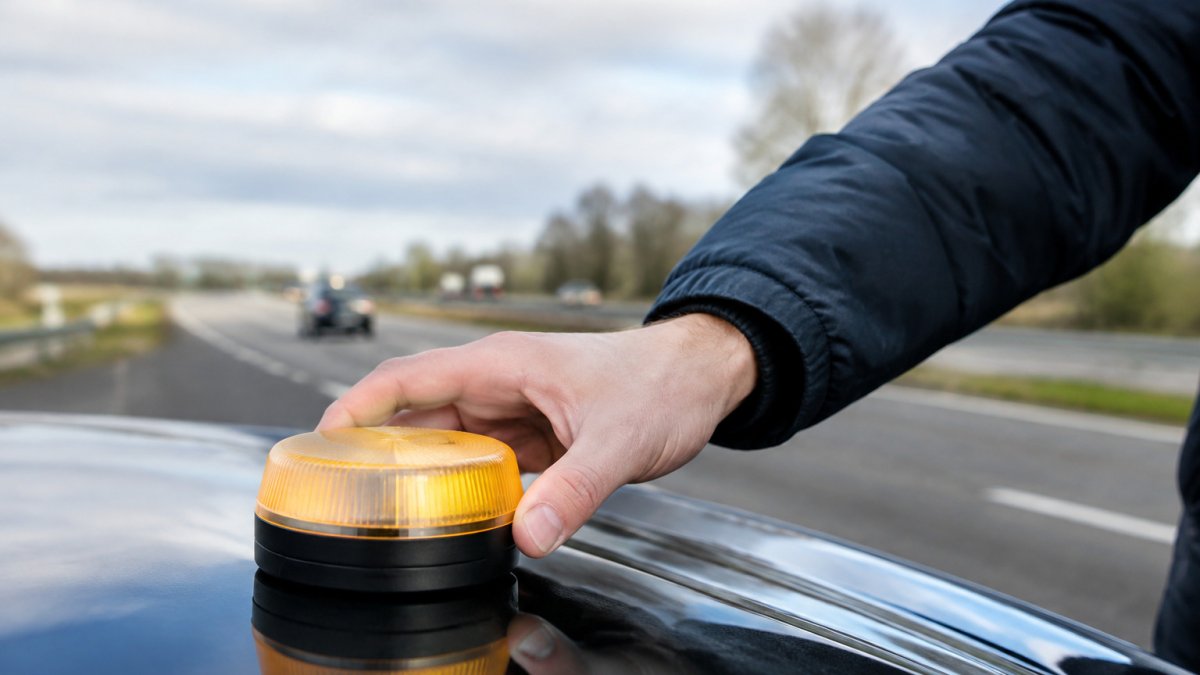
A V16 beacon is a small, battery-powered amber light that a driver places on the roof of a stationary vehicle to warn other road users of a breakdown or hazard. Roadflash offers DGT 3.0 compliant emergency beacons with GPS geolocation and high-visibility lighting, designed to reduce the risk of collisions with stopped vehicles on busy roads.
Many drivers assume a reflective triangle and hazard lights are enough. For some journeys they are not. A stationary car on a motorway hard shoulder is hard to see at speed, especially at night or in poor weather.
The main reason to consider one is how often you travel at speed. If you commute on motorways or drive regularly on fast roads, a beacon fits the risk you actually face. If you only drive short urban journeys, your need is lower, though the same logic still applies wherever a vehicle may stop unexpectedly.
Checking Which DGT 3.0 Compliant Emergency Beacons Apply to Your Vehicle
Before you buy, confirm that the beacon meets the rules that apply where you drive. In Spain, the DGT 3.0 system requires compliant emergency beacons for many vehicles, and drivers should check the current requirements on the official Dirección General de Tráfico (DGT) official website.
Start by checking whether your vehicle type and routes fall under the rule. Then look for the certification marking on the product itself and in its documentation. A beacon labelled as compliant should show clear approval details, not just a general claim.
If you are unsure whether your beacon qualifies, check the product page and ask the seller to confirm the exact model’s approval status before you rely on it.
Our advice is to treat compliance as a first filter. Any beacon that cannot show its approval details should be ruled out, however attractive the price or features.
Key Features to Compare: Connectivity, GPS and Battery Life
Once you have confirmed compliance, compare the features that affect real-world performance. The three that matter most are connectivity, geolocation and battery behaviour, and each has a trade-off that is easy to miss on a product page.
Connectivity: Check which network technology the beacon uses and whether it transmits location data to the relevant emergency services. Confirm that the model supports the network bands used in the countries you drive through, and ask the seller whether the beacon requires a separate data plan or subscription. A beacon that needs a contract you have not set up may not transmit when it matters.
GPS and geolocation: Accurate geolocation helps emergency services and roadside assistance find your vehicle quickly. Look for a model that states its positioning method (GPS, GNSS or a combination) and how long it takes to acquire a fix after activation. A cold start can take longer than a warm start, so a beacon that has been sitting in a cold boot for weeks may take a minute or more to report its position. Confirm whether the beacon transmits location data automatically on activation or requires a button press, and whether it stores the last known position if connectivity drops.
Battery life: A beacon is only useful if it is charged when you need it. Compare stated battery life in standby and in active transmission, because the two are very different. A unit that claims months of standby may only transmit for a few hours. Check the charging method (USB-C is now common, but some units use a proprietary dock), how the unit behaves when the battery runs low (a visual or audible warning is better than silent failure), and whether the battery is user-replaceable or sealed. Sealed units are more waterproof but become disposable when the cell degrades.
Durability and IP rating: If you drive in all weathers, check the ingress protection rating. An IP54 rating resists dust and splashes; IP67 tolerates temporary immersion. A beacon that lives in a glovebox or boot should at least be splash-resistant, and one that is mounted externally needs a higher rating. Watch out: a high IP rating does not guarantee the charging port cover stays sealed after repeated use, check the design of the port flap.
Write down these points for each model you consider: network bands supported, subscription requirement, cold-start time, standby versus active battery life, charging method and IP rating. Comparing them side by side makes the trade-offs clear and stops you choosing on looks or price alone.
The table below summarises the three features the article asks you to compare, with the trade-off to watch for in each.
| Feature | What to check | Trade-off to watch |
|---|---|---|
| Connectivity | Network bands and subscription need | Beacon may not transmit without a contract |
| GPS and geolocation | Positioning method and fix time | Cold start can take a minute or more |
| Battery life | Standby versus active transmission | Months of standby may mean only hours of transmission |
| Durability | IP rating and port cover design | High IP rating does not guarantee a sealed charging port |
Matching a V16 Beacon to Your Driving: Motorways, Rentals and Fleets
Your driving pattern should shape your choice, but the practicalities differ sharply between private, rental and fleet use. This section covers the checks that most buying guides skip.
Motorway commuters: If you drive fast roads regularly, prioritise visibility range, reliable connectivity and fast activation. A beacon that is easy to deploy from the driver’s seat or from the boot is worth more than a cheaper unit that is fiddly in an emergency. Check that the magnetic base or mounting method holds at motorway speeds and that the activation button can be found by touch in the dark. A beacon with a clear status light, so you can see it is transmitting without opening an app, is a practical advantage.
Rental car drivers: If you are renting a car, do not assume a compliant beacon is in the vehicle. Before you leave the rental lot, check that a beacon is present and that it carries visible approval markings. If no beacon is supplied, check the local requirement for your destination before you drive away, the obligation may fall on the driver, not the rental company. Keep a photo of the approval marking and the rental agreement in case you are stopped.
Fleet operators: If you manage several vehicles, consistency matters. Standardising on one compliant model simplifies training, spares and documentation. Build a simple register of vehicle registration, beacon serial number, approval reference, last charge date and next check date. Check how each unit is charged and whether the charging cable is stored with the vehicle. For mixed fleets, confirm that the same model suits the vehicle types you operate, including any with non-metallic roofs.
Occasional and urban drivers: If you only drive short urban journeys, your need is lower, but the same logic applies wherever a vehicle may stop unexpectedly. A compact unit that lives permanently in the glovebox and is checked quarterly is a reasonable compromise. Watch out: a beacon stored in a hot car for long periods can degrade its battery, so check the manufacturer’s storage temperature range.
How to Use a V16 Emergency Light Correctly After a Breakdown
Using a beacon correctly takes seconds, but the order matters for your safety.
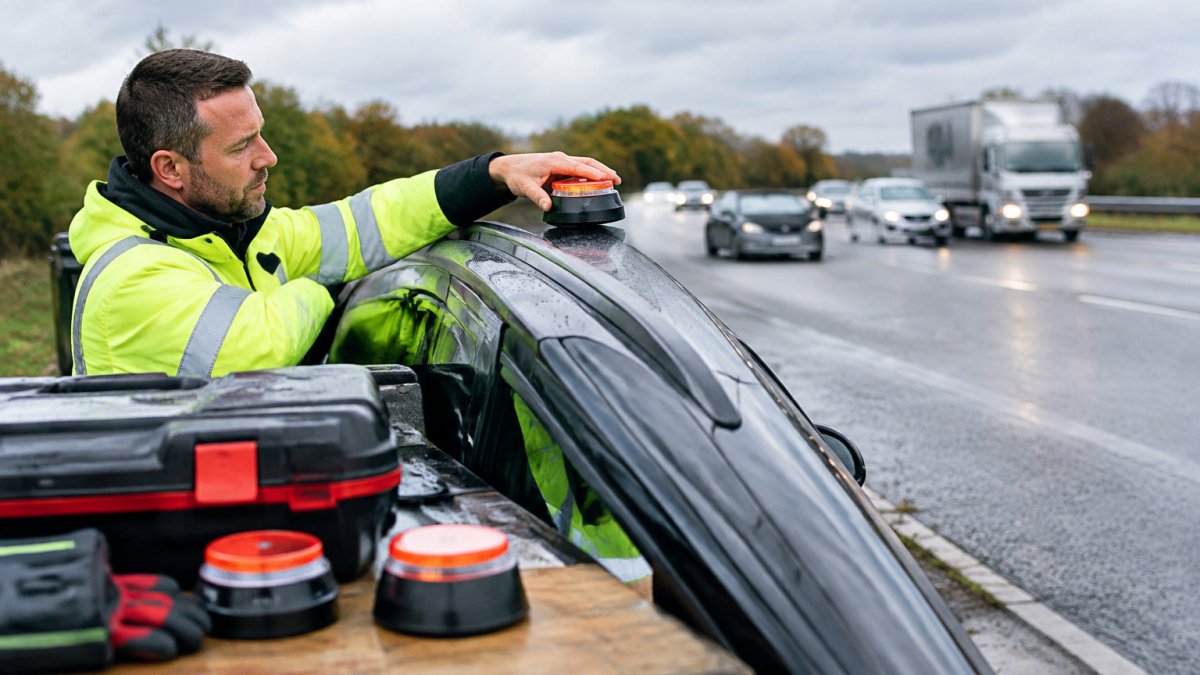
- Stop safely. Pull onto the hard shoulder or the safest available space, well away from the traffic lane. Turn on your hazard lights.
- Stay in the vehicle if it is unsafe to exit. On a fast road, getting out can be more dangerous than staying put with your seatbelt on. Check conditions before you move.
- Place the beacon. If it is safe, wear a high-visibility jacket and place the beacon on the roof of the vehicle, where it can be seen from behind. Make sure it is secure before you step away.
- Confirm it is active. Check the light is switched on and, if your model shows status, that location transmission is working.
- Move to safety. Get behind a barrier where you can, and call for assistance.
A common mistake is placing the beacon inside the car or on the boot lid, where it is partly hidden. Another is forgetting to check the battery before a long trip. Charge the unit regularly and test it before you set off.
Many drivers also pair the beacon with a high-visibility vest, which you should wear whenever you leave the vehicle on a road.
European Driving Safety Regulations for UK Motorists
If you are a UK motorist driving in Europe, the rules that apply where you are travelling matter more than those at home. Requirements for warning devices, and whether a beacon is compulsory, vary by country, so check each destination before you travel.
Rules for vehicles registered in the UK can differ from those for vehicles registered in an EU member state, and they can change. Consult the official government guidance for the countries on your route, and check the requirements for your specific vehicle type.
Keep your beacon’s approval documents with you when you travel, and make sure the unit is charged before you cross the border.
Next Step: Compare Roadflash Beacons and Request a Quote
Choosing the right V16 beacon comes down to three checks: confirm the approval that applies to your vehicle and routes, compare connectivity, GPS and battery life, and match the device to how you actually drive. Work through those in order and you will avoid most of the common mistakes.
Roadflash offers DGT 3.0 compliant emergency beacons with GPS/geolocation and high-visibility lighting. Pricing depends on quantity, delivery and the model you choose, so check the current range on the Roadflash website or request a quote for your vehicle or fleet.
Frequently Asked Questions
What is a V16 beacon and why is it required?
A V16 beacon is a battery-powered emergency light that is placed on the roof of a stationary vehicle to warn approaching traffic of a breakdown or hazard. Spain has specific rules on emergency warning devices, so check the current official requirements before travelling. Requirements differ between countries, so UK motorists driving abroad should check the rules for each country they will visit before travelling. Roadflash offers DGT 3.0 compliant beacons with GPS/geolocation. Pricing depends on quantity, delivery and the model you choose, so check the Roadflash website for current prices.
Are V16 beacons mandatory for UK-registered cars driving in Europe?
This depends on the country being visited. Some European countries require drivers to carry an approved emergency warning device, so check the rules for each destination. UK-registered vehicles are subject to the same rules as local vehicles when driving in those countries. Check the current rules for each destination on official government travel guidance before departure, and make sure the device you buy carries the certification the destination requires.
What features should I look for when buying a V16 beacon?
Focus on certification for the country you will drive in, since a DGT 3.0 compliant beacon is needed for Spain. Check whether the unit has GPS or geolocation, the connectivity it uses, and whether it has a base that holds firmly to a roof. Battery life, the IP rating for weather resistance, and how easily the light can be switched on are also worth comparing. Matching these details to your driving pattern helps you avoid paying for features you will not use.
Is a DGT 3.0 compliant beacon necessary for my vehicle?
If you drive in Spain, a DGT 3.0 compliant beacon is the version that meets the current Spanish requirement, so it is the one to choose for that trip. Compliance is about the device’s certification rather than the vehicle type, so check the certification on each product before buying. Confirm the certification marking on the product before buying, and check the Roadflash product pages for current details.
