

Why Hazard Lights Are Not Enough
Table of Contents
- Why Hazard Lights Are Not Enough on Modern Roads
- When to Use Hazard Lights: Legal and Practical Scenarios
- Highway Code Rule 116 and What It Actually Requires
- The Real Danger: Why Hazard Lights Cause Driver Confusion
- Driving in Heavy Rain Safety Tips: Why Hazard Lights Fail
- What Actually Works Better Than Hazard Lights
- Protecting Yourself During a Breakdown: A Practical Approach
- Conclusion
Last Updated: August 13, 2026
Why Hazard Lights Are Not Enough on Modern Roads
Hazard lights were designed to alert stationary traffic to a parked vehicle, not to warn approaching drivers of collision risk at high speed. At Roadflash, we’ve analysed hundreds of breakdown incidents and near-misses, and the evidence is clear: relying solely on hazard lights leaves drivers dangerously exposed, particularly during adverse weather or at night. The problem isn’t that hazard lights don’t work; it’s that they don’t work well enough when seconds matter most. When a vehicle breaks down on a motorway, other drivers need clear, immediate, unambiguous warning that hazard lights fail to deliver.
This guide explores why hazard lights are not enough, what the law actually requires, and what genuinely works better to protect you and your passengers during a breakdown.
When to Use Hazard Lights: Legal and Practical Scenarios
Hazard lights serve a specific purpose under UK traffic law, but many drivers misunderstand when they’re appropriate.
Emergency stopping and vehicle breakdowns
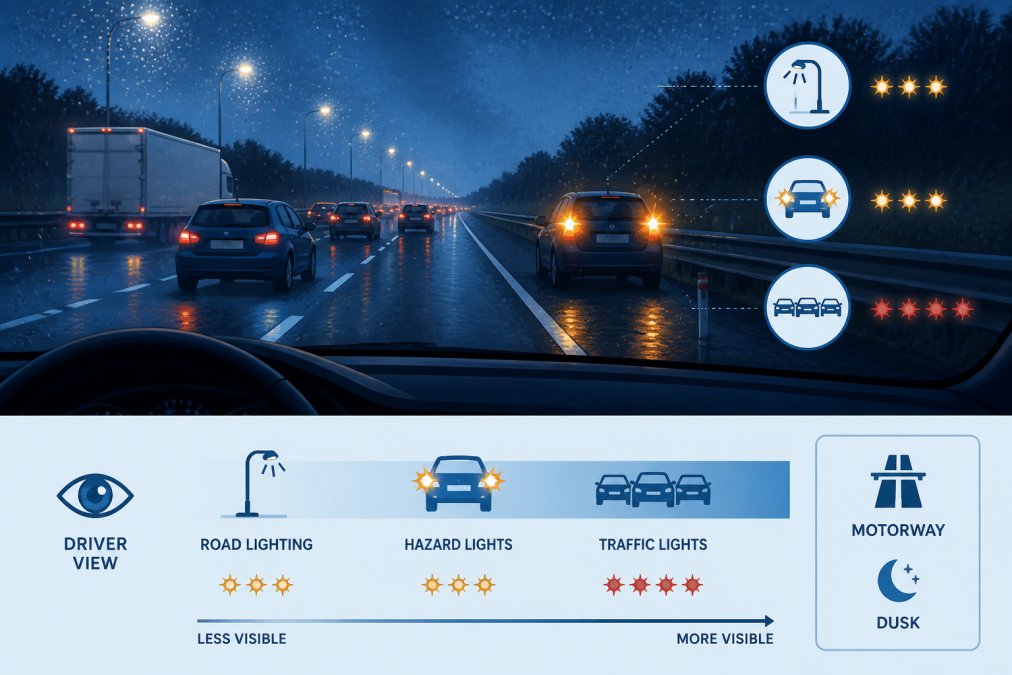
The Highway Code permits hazard lights when your vehicle is temporarily obstructed or broken down. Rule 116 specifically addresses this scenario: hazard lights should be used to warn other traffic when your vehicle is stationary due to an emergency or breakdown. However, the rule assumes daylight conditions and relatively low traffic speeds, assumptions that don’t hold on a busy motorway at dusk or in heavy rain.
When your vehicle breaks down on a motorway hard shoulder, switching on hazard lights is the first step. But it’s only the first step. The flashing lights alert nearby traffic that something is wrong, but they don’t communicate your location clearly to traffic approaching from 500 metres away. Many breakdown incidents occur within minutes of a vehicle stopping, before recovery services arrive. In that critical window, hazard lights alone create a false sense of security for the driver and insufficient warning for approaching traffic.
Hazard lights while moving: what the rules permit
Hazard lights should not be used while driving normally. The Highway Code is clear: hazard lights are for stationary vehicles only. Using them while moving creates confusion because other drivers interpret flashing lights as a warning to stop, but if you’re moving at motorway speed, that message contradicts your actual trajectory. This driver confusion is one of the core reasons why hazard lights are not enough in emergency situations.
Highway Code Rule 116 and What It Actually Requires
Rule 116 states: "Use hazard warning lights when your vehicle is stationary or moving, to warn that it is temporarily obstructed." This rule permits hazard lights but doesn’t mandate them as sufficient protection. It acknowledges that stationary vehicles need warning systems, but it doesn’t specify what level of visibility or warning distance is adequate.
The Highway Code also references Rule 283, which requires vehicles to carry warning triangles or use hazard lights. This either/or framing is telling: the code recognises that hazard lights are one option among several, not the optimal solution in all situations. Many professional drivers and emergency services personnel carry both hazard lights and reflective warning triangles because they understand that redundancy saves lives.
The Real Danger: Why Hazard Lights Cause Driver Confusion
Hazard lights communicate ambiguity rather than clarity. A flashing light pattern doesn’t convey specific information about the nature of the hazard, the location of the vehicle, or the appropriate driver response.
How flashing lights disable turn signal communication
When hazard lights are activated, they override the turn signal system. Both front and rear indicators flash simultaneously. For approaching drivers, this creates a critical problem: they cannot determine whether the vehicle ahead is turning, stopping, or broken down. Turn signals communicate intent; hazard lights communicate distress. But when hazard lights are on, the turn signal information is lost entirely.
Professional drivers and traffic management personnel have long recognised this limitation. That’s why many use additional visual markers, reflective triangles, high-visibility vests, or GPS-enabled beacons that communicate specific information without relying on ambiguous light patterns.
The psychological effect on approaching drivers
Hazard lights trigger urgency mixed with uncertainty. When drivers see flashing lights, their attention sharpens, but their interpretation of the hazard remains unclear. This uncertainty often leads to poor decision-making at high speed. Some drivers brake suddenly; others attempt to change lanes without proper signalling. In heavy traffic, a sudden braking response to hazard lights can trigger a chain reaction of collisions.
Research into driver behaviour shows that clear, unambiguous warnings produce better outcomes than ambiguous ones. A stationary vehicle with hazard lights produces ambiguity. A stationary vehicle with hazard lights, a reflective triangle, and high-visibility equipment produces clarity.

Driving in Heavy Rain Safety Tips: Why Hazard Lights Fail
Adverse weather exposes the limitations of hazard lights most starkly. In heavy rain, fog, or low visibility conditions, hazard lights become nearly useless as a primary warning system.
Visibility limitations in fog and adverse weather conditions
Hazard lights are designed to be visible in daylight and normal night-time conditions. In fog, their effectiveness drops dramatically. The flashing pattern becomes diffused by water droplets and mist. An approaching driver sees a faint glow rather than a clear warning. The light is absorbed or scattered before it reaches the vehicle behind, reducing the effective warning distance significantly.
Fog represents one of the most dangerous driving conditions, yet it’s precisely when hazard lights fail most completely. A vehicle broken down in fog with only hazard lights activated is almost invisible to traffic approaching at motorway speeds. Heavy rain creates a similar problem: raindrops on windscreens reduce visibility further, and hazard lights may be visible at only 20 metres in heavy rain. At motorway speeds, that’s less than one second of reaction time.
How rear fog lights compare to hazard lights
Rear fog lights are a legal requirement on UK vehicles and serve a specific purpose: to increase visibility in fog and heavy rain. They’re brighter than standard tail lights and use a steady glow rather than flashing. This steady pattern is more visible in fog than flashing lights because it doesn’t rely on the timing of the flash to be perceived by the approaching driver.
However, rear fog lights are designed for moving vehicles, not stationary ones. The most effective approach combines multiple warning systems: hazard lights for immediate alert, rear fog lights for visibility in adverse weather, a reflective triangle for stationary warning, and ideally a GPS-enabled beacon for maximum visibility and emergency service location.
What Actually Works Better Than Hazard Lights
The evidence points clearly to supplementary warning systems that provide clearer, more reliable protection than hazard lights alone.
Early warning systems and GPS-enabled beacons
GPS-enabled emergency beacons represent a significant advancement in breakdown safety. These devices provide high-visibility warning to approaching traffic and transmit the vehicle’s exact location to emergency services and recovery teams.
A GPS-enabled beacon typically uses LED technology with multiple light points, creating a more visible warning pattern than a single flashing light source. The beacon is mounted at a higher point on the vehicle, increasing its visibility range. Approaching drivers see a clear, bright warning from 200-300 metres rather than 50-100 metres with hazard lights alone.
When emergency services receive a breakdown call, they can see the vehicle’s exact GPS coordinates, eliminating time wasted searching for the vehicle along a motorway stretch. For an injured or disoriented driver, this rapid location capability can be life-saving. Roadflash’s GPS-enabled emergency beacons are specifically designed for stationary vehicles on busy highways, providing the visibility and location data that hazard lights cannot.
Reflective triangles and high-visibility equipment
Reflective warning triangles have been used for decades and remain one of the most effective stationary vehicle warnings. They provide passive, continuous visibility without requiring power or electronics. A reflective triangle placed 45 metres behind a stationary vehicle on a motorway gives approaching drivers approximately 10 seconds of warning at 70 mph, enough time to brake safely.
High-visibility vests serve a complementary purpose. If the driver needs to exit the vehicle, high-visibility clothing makes them immediately apparent to approaching traffic. The combination of reflective triangles, high-visibility vests, and hazard lights meets legal requirements and provides reasonable protection. However, in poor visibility conditions, GPS-enabled beacons address these limitations by providing active, electronic warning with location data.
Protecting Yourself During a Breakdown: A Practical Approach
When your vehicle breaks down on a motorway or busy highway, a systematic approach maximizes safety for you and other road users.
First, activate hazard lights immediately. Second, if safe to do so, exit the vehicle and move to a safe location away from traffic, typically behind a barrier or on the verge. Third, place reflective warning triangles 45 metres behind your vehicle (or use hazard lights if triangles aren’t available). Fourth, wear high-visibility clothing if you must remain outside the vehicle. Fifth, activate a GPS-enabled emergency beacon if you have one. Sixth, contact breakdown recovery services and provide them with your location.
The key principle: layered warnings work better than single warnings. Hazard lights alone leave too much to chance. Hazard lights plus reflective triangles provide better protection. Hazard lights plus reflective triangles plus high-visibility clothing plus a GPS-enabled beacon provide comprehensive protection.
If you travel motorways regularly, carrying a GPS-enabled emergency beacon is one of the most effective safety investments you can make. Unlike reflective triangles or hazard lights, a beacon works in all weather conditions and provides emergency services with your exact location, critical information if you’re injured or unable to communicate clearly.
When your vehicle breaks down on a busy road, hazard lights are the starting point, not the finish line. The evidence is overwhelming: hazard lights alone are insufficient to prevent collisions, particularly in adverse weather or at night. Reflective triangles, high-visibility equipment, and GPS-enabled beacons address the limitations that hazard lights cannot overcome. Roadflash’s multi-award-winning emergency beacons are specifically engineered to provide the visibility and location data that motorway safety demands. By combining hazard lights with these supplementary systems, you transform a dangerous situation into a manageable one. Your safety, and the safety of approaching drivers, depends on clear, unambiguous warning. Hazard lights provide one layer; modern early warning systems provide comprehensive protection.
Frequently Asked Questions
Are hazard lights a legal requirement when broken down?
The Highway Code advises using hazard lights when stationary and causing an obstruction, but hazard lights alone do not meet full safety requirements. Rule 116 states you should use them, but this must be combined with other measures such as reflective warning triangles or high-visibility clothing. Many accidents occur because hazard lights alone fail to alert approaching drivers in time, particularly in low visibility or heavy rain. Early warning systems with greater range offer superior protection beyond what hazard lights provide.
Why are hazard lights insufficient in heavy rain or fog?
Hazard lights have limited range and visibility in adverse weather. Heavy rain, fog, and spray reduce how far their flashing pattern can be seen by approaching drivers. Visibility can drop to just 50 metres in heavy downpour, whilst vehicles may be travelling at 70 mph or faster. By the time a driver spots flashing hazard lights through poor visibility, they have insufficient time to brake safely. GPS-enabled warning systems and high-visibility beacons with extended range provide earlier detection and give other road users critical extra seconds to react.
Can using hazard lights while driving cause confusion for other road users?
Yes. When hazard lights are activated, they override the turn signal function, preventing you from communicating your intended direction to other drivers. This creates dangerous ambiguity: approaching vehicles cannot tell if you're turning left, turning right, or simply warning of an obstruction. In traffic, this confusion increases collision risk. The Highway Code advises against using hazards while moving for this reason. Proper signalling with turn indicators, combined with hazard lights only when stationary, maintains clear communication and road safety.
What should I do instead of relying only on hazard lights during a breakdown?
Use a multi-layered approach: activate hazard lights, switch on your headlights and rear fog lights if visibility is poor, wear high-visibility clothing, and deploy a reflective warning triangle at least 45 metres behind your vehicle. For motorway breakdowns, consider early warning systems with GPS and extended visibility range, which alert approaching traffic far earlier than traditional hazard lights alone. Exit the vehicle safely, move to the hard shoulder away from traffic, and call for roadside assistance. These combined measures significantly reduce the risk of secondary collisions compared to hazard lights alone.
This article was written using GrandRanker