

Emergency Beacon vs Reflective Warning Triangle: 2026 UK Guide
Table of Contents
- Emergency Beacon vs Reflective Warning Triangle: Key Differences
- Visibility and Detection Range Explained
- Deployment Speed and Ease of Use
- UK Motorway Breakdown Safety Rules and Legal Requirements
- Reflective Triangle Placement Distance and Best Practice
- Battery Life, Power Source and Durability
- Best Roadside Emergency Lights 2025: Feature Comparison
- Real-Time Connectivity and IoT Features
Emergency Beacon vs Reflective Warning Triangle: 2026 UK Guide
Last Updated: August 4, 2026
When your vehicle breaks down on a busy motorway, those first few seconds determine whether other drivers see you in time. The choice between an emergency beacon vs reflective warning triangle isn’t just about preference, it’s about survival. According to research from the Department for Transport, stationary vehicles on motorways face collision risks that increase dramatically without adequate warning systems. This guide breaks down the key differences across visibility, deployment speed, legal compliance, and the human factors that matter most when seconds count.
Active vs Passive Safety Mechanisms
A reflective warning triangle is a passive device that reflects light from vehicle headlights back to the driver’s eyes. An emergency beacon is an active device that generates its own light source through LED flashing patterns, regardless of ambient light or oncoming headlights.
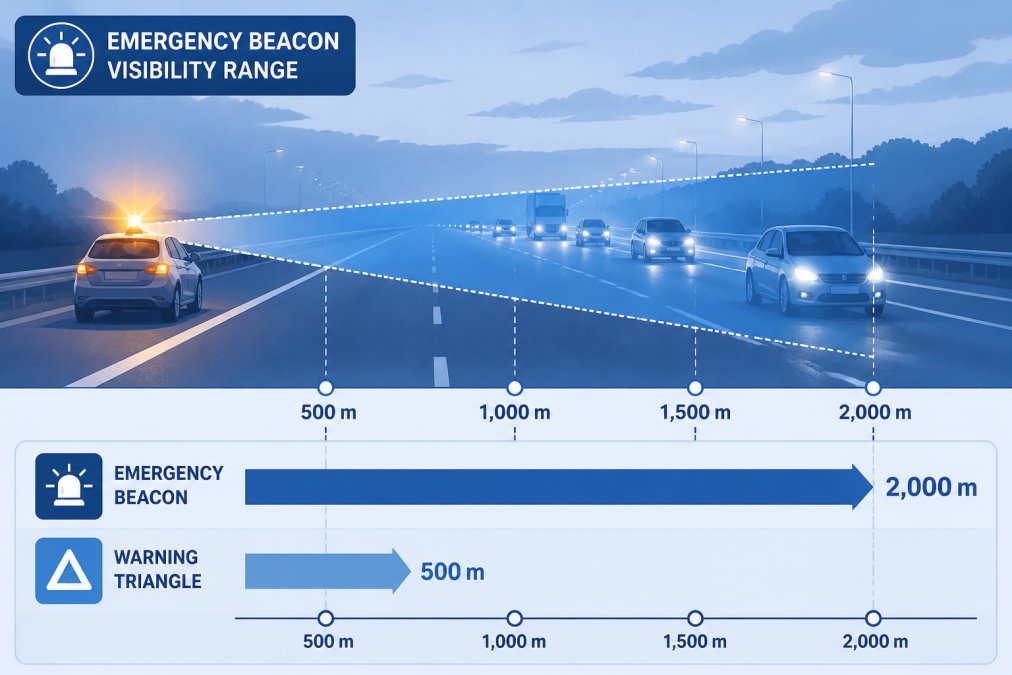
This distinction is critical. Passive reflection depends entirely on external light sources and angle of approach. In fog, heavy rain, or darkness without oncoming traffic, a reflective triangle becomes nearly invisible. Active beacons solve this by creating their own visual signal, visible from much greater distances and in conditions where passive reflection fails completely.
When a driver sees an active flashing light, their brain registers an immediate hazard alert. Research into driver perception shows that active warning signals reduce reaction time compared to passive reflectors, a critical advantage at motorway speeds.
The real safety advantage of active beacons isn’t just brightness, it’s predictability. A flashing pattern at a consistent frequency creates a clear “something is wrong here” signal that drivers process faster than interpreting why a reflective surface suddenly appeared in their headlights.
Visibility and Detection Range Explained
LED Flashing Light Performance
Modern LED emergency beacons achieve visibility distances that passive triangles cannot match. A high-quality LED beacon like the OSRAM LEDguardian ROAD FLARE Signal V16 produces 360-degree visibility with a yellow-orange flashing pattern visible from distances exceeding 300 metres in daylight conditions. At night, visibility extends to 500 metres or more depending on atmospheric conditions.
The advantage compounds in adverse weather. Fog, rain, and spray that reduce reflective triangle visibility by 50-70% have minimal impact on active LED beacons. Because LED beacons are typically placed on the vehicle roof, they sit higher than ground-level triangles, improving sightlines over traffic and giving drivers more time to react safely.
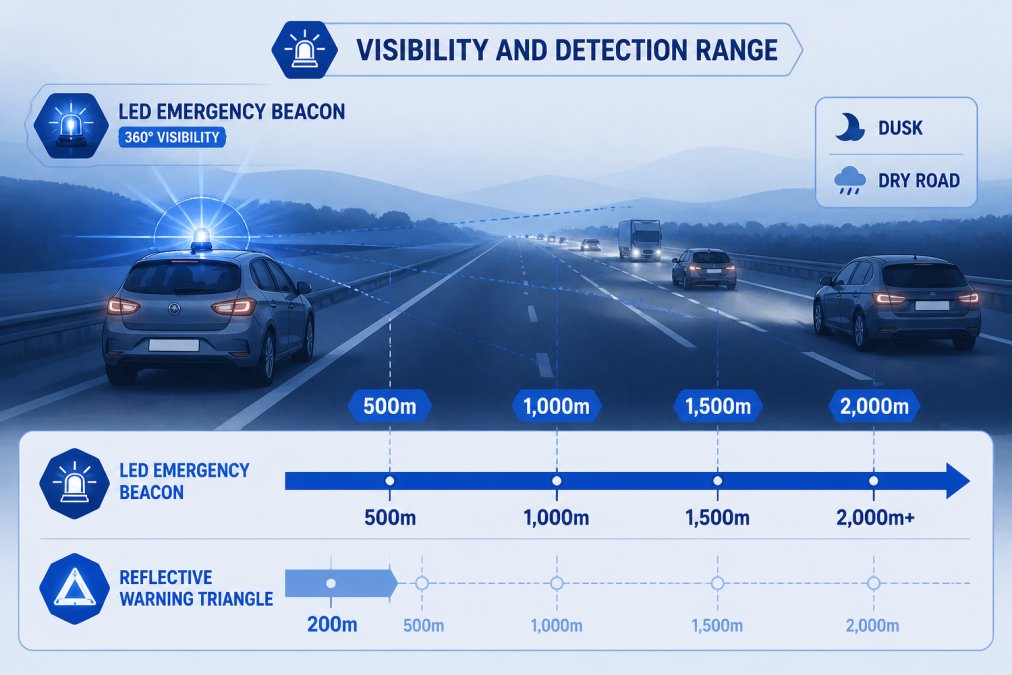
Passive Reflector Effectiveness
Reflective warning triangles offer high reflectivity when struck by headlights, typically visible from 150-200 metres in clear conditions. This distance shrinks dramatically in poor visibility. The critical limitation: triangles only work when headlights illuminate them. A vehicle approaching without headlights, a distracted driver, or conditions where headlight beams scatter all reduce triangle effectiveness. In daylight, passive triangles become nearly invisible unless placed directly in a driver’s line of sight.
UK guidance recommends positioning triangles 45 metres behind a broken-down vehicle on A-roads, but regulations actually prohibit their use on motorways entirely. This creates a compliance gap: triangles are legal on A-roads and B-roads but not where they’re most needed.
Deployment Speed and Ease of Use
An LED emergency beacon typically deploys in 5-10 seconds. Magnetic-base models attach to a vehicle roof instantly, and some can be activated from inside the vehicle, eliminating the need to exit into traffic. This matters profoundly, stationary vehicles on motorways are at risk from passing traffic, and the longer a driver remains outside their vehicle, the higher the collision risk.
Reflective triangles require manual placement. Even experienced drivers spend 30-45 seconds positioning a triangle 45 metres behind their vehicle, requiring them to walk along the roadside while traffic passes. In darkness, this increases risk significantly. Weather conditions affect deployment differently: rain, wind, and cold make handling a physical triangle more difficult and slower. LED beacons deploy identically regardless of weather.
The biggest deployment mistake drivers make with triangles is underestimating the time required. What should take 30 seconds often takes 60+ seconds in real conditions, darkness, and traffic stress, leaving the driver exposed for twice as long as they expect.
UK Motorway Breakdown Safety Rules and Legal Requirements
Motorway Regulations and Triangle Restrictions
UK law explicitly prohibits reflective warning triangles on motorways. The Motorway Traffic Regulations state that drivers must not place triangles on the hard shoulder or between lanes. Motorways are where breakdowns happen most frequently and collision risks are highest, yet the traditional triangle is illegal in precisely these locations.
The legal requirement on UK motorways is to activate hazard warning lights and remain inside the vehicle with the engine off and doors locked. For additional safety, drivers should use an emergency refuge area if available, or call emergency services from inside the vehicle. Roadflash’s multi-award-winning emergency beacons with GPS/Geolocation features align with these regulations while providing active warning that exceeds minimum legal requirements.
DGT 3.0 Compliance for European Travel
If you drive in Spain or plan European travel, DGT 3.0 compliance becomes mandatory. Spain requires vehicles to carry emergency beacons meeting DGT 3.0 standards (effective 2026), which specify active warning devices with specific brightness, flashing patterns, and visibility requirements. Reflective triangles alone no longer satisfy Spanish requirements.
Roadflash’s emergency beacons meet DGT 3.0 standards, making them legal across UK and European travel scenarios. By 2026, most European nations are aligning on active beacon requirements, making passive triangles increasingly obsolete for safety-conscious drivers.
Reflective Triangle Placement Distance and Best Practice
Traditional guidance specifies placing warning triangles 45 metres behind a broken-down vehicle. However, this distance provides insufficient warning time at motorway speeds. A vehicle travelling at 70 mph covers 45 metres in approximately 1.6 seconds, barely time for a distracted driver to react.
Placement also introduces risk. Drivers must exit their vehicle, walk along the roadside, and position the triangle while traffic passes. The further back the triangle (for better early warning), the longer the driver spends outside their vehicle, a trade-off with no good solution.
The 45-metre rule works in theory but fails in practice. By the time a driver sees a reflective triangle at night or in poor visibility, they’re already too close to safely brake and change lanes. Active beacons solve this by providing visible warning from 300+ metres, giving drivers the reaction time they actually need.
Battery Life, Power Source and Durability
Battery Longevity and Maintenance
LED emergency beacons typically operate on AA, 9V, or rechargeable lithium batteries. A standard 9V battery powers most beacons for 8-12 hours of continuous flashing. In practice, a beacon battery lasts 3-5 years if checked annually and replaced when visual inspection shows corrosion.
Rechargeable models eliminate battery replacement concerns entirely. They charge via USB and hold power for weeks between uses. For fleet operators and professional drivers, rechargeable models reduce long-term cost and eliminate the risk of discovering dead batteries during an actual breakdown.
Reflective triangles require no power source, but reflective surfaces degrade over time, losing reflectivity as UV exposure and weathering damage the coating. A triangle that appears fine visually may have lost 30-40% of its reflective effectiveness after 3-4 years of sun exposure.
Weather Resistance and Build Quality
Quality LED beacons meet IP54 protection standards, resisting dust and water ingress in typical weather conditions. They withstand rain, fog, and wind without performance degradation. The magnetic mounting system holds securely even at motorway speeds.
Reflective triangles are strong in construction but vulnerable to weather damage over extended periods. Reflective coating degrades from UV exposure, and the metal frame can rust if stored in damp conditions. LED beacons maintain consistent performance across temperature ranges (-10°C to +50°C), while reflective surfaces show measurable performance degradation in extreme cold.
| Feature | LED Emergency Beacon | Reflective Warning Triangle |
|---|---|---|
| Visibility Distance (daylight) | 300+ metres | 150-200 metres |
| Visibility in fog/rain | Excellent | Poor (reduced 50-70%) |
| Deployment Time | 5-10 seconds | 30-45 seconds |
| UK Motorway Legal | Yes | No (prohibited) |
| DGT 3.0 Compliant | Yes (Roadflash models) | No |
| Battery Life | 8-12 hours continuous | N/A |
| Weather Resistance | IP54 standard | Good but degrades over time |
| Requires Driver to Exit Vehicle | No | Yes |
| Best For | Motorways, poor visibility, frequent travel | A-roads, B-roads, occasional use |
Best Roadside Emergency Lights 2025: Feature Comparison
Emergency Beacon Options
Roadflash Emergency Beacon (Multi-Award-Winning)
Roadflash’s emergency beacons represent the pinnacle of UK motorway safety innovation. Their DGT 3.0 compliant models feature GPS/Geolocation capabilities that transmit your exact location to emergency services, eliminating the uncertainty of roadside positioning. The beacons deliver 360-degree yellow-orange flashing visibility at distances exceeding 300 metres, with magnetic mounting for instant deployment from inside the vehicle.
The GPS integration is the critical differentiator. When activated, Roadflash beacons automatically send your location to emergency responders, reducing response time and ensuring accurate vehicle location even on featureless motorway sections. For drivers who value maximum safety and regulatory compliance, Roadflash beacons deliver both.
OSRAM LEDguardian ROAD FLARE Signal V16
The OSRAM LEDguardian offers excellent visibility at a competitive price point. Its 360-degree yellow-orange flashing light is visible from approximately 300 metres in daylight, with IP54 weather protection and magnetic base for quick roof mounting. It operates on a 9V battery or optional rechargeable Li-Ion battery.
The V16 performs well in adverse weather and provides reliable visibility across typical UK breakdown scenarios. However, it lacks GPS integration, meaning emergency services must rely on driver-provided location information.
BriteAngle LED Road Safety Warning Triangle
BriteAngle combines LED flashing lights with reflective panels, creating a hybrid approach. Its high-intensity LED lights are visible up to 300 metres, and the reflective surface provides backup visibility if batteries fail. It’s weather-resistant and includes a suction bracket for windscreen mounting.
The hybrid design appeals to drivers seeking both active and passive warning, though the suction bracket mount is less secure than magnetic systems.
Reflective Triangle Options
AA Emergency Warning Triangle
The AA triangle meets ECE R27 standards and offers maximum reflectivity in its class. It folds compactly, includes a carry case, and requires no batteries or maintenance. For drivers using A-roads and B-roads, it provides reliable visibility when conditions favour passive reflection.
RAC Emergency Warning Triangle
The RAC triangle is functionally equivalent to the AA model, ECE R27 compliant, highly reflective, and compact. It includes a stand for roadside deployment and is often included in RAC breakdown cover packages.
Real-Time Connectivity and IoT Features
GPS Location and Digital Alerts
The most significant recent innovation in roadside safety is GPS-enabled emergency beacons. Roadflash’s beacons integrate geolocation that automatically transmits your vehicle’s exact position to emergency services when activated. This eliminates the dangerous communication gap that exists with traditional systems.
Consider a realistic scenario: a driver is injured in a breakdown, disoriented, or unable to clearly communicate their location. With GPS-integrated beacons, emergency responders know your exact position within metres, allowing them to locate and assist you faster.
The digital connectivity also enables integration with vehicle telematics systems. Fleet operators can track beacon activations in real time, alerting dispatch to send recovery vehicles to the exact location. As autonomous vehicles become more prevalent, beacons that transmit digital warnings to vehicle sensors will provide safety benefits impossible with passive reflection or standalone active devices.
Drivers who spend significant time on motorways, particularly those driving alone or in unfamiliar areas. The GPS integration removes location uncertainty and accelerates emergency response, critical advantages during high-stress breakdown situations.
When your vehicle breaks down on a busy motorway, every second matters. The choice between an emergency beacon and a reflective warning triangle determines whether approaching drivers see you in time. Roadflash’s multi-award-winning emergency beacons with GPS/Geolocation integration combine active LED visibility with real-time location transmission, addressing critical gaps in traditional safety systems. Their DGT 3.0 compliance ensures legal coverage across UK and European travel, while magnetic deployment eliminates the need to exit your vehicle into traffic. For motorway safety that goes beyond minimum legal requirements, Roadflash beacons deliver the visibility and connectivity that modern breakdown scenarios demand. Add to basket and drive with confidence knowing that help can find you faster.
Frequently Asked Questions
Can you use a reflective warning triangle on UK motorways?
No. The UK Department for Transport prohibits reflective warning triangles on motorways. Instead, you must use an emergency beacon or activate your hazard warning lights and call emergency services. This rule exists because drivers must exit the vehicle to place a triangle, exposing them to high-speed traffic. Emergency beacons can be deployed safely from inside the vehicle, making them the compliant alternative for motorway breakdowns.
What visibility distance should an emergency beacon achieve compared to a reflective triangle?
Active LED emergency beacons are typically visible from 300 metres or more in daylight and night conditions. Reflective triangles depend entirely on ambient light and vehicle headlights, usually visible from 50-100 metres in low light. This extended visibility range of beacons significantly increases driver reaction time, allowing vehicles to slow down sooner and avoid collisions with stationary vehicles.
How quickly can you deploy each device during a breakdown?
Emergency beacons with magnetic bases deploy in seconds from inside your vehicle, eliminating exposure to traffic. Reflective triangles require you to exit the vehicle and walk to a safe distance (typically 45 metres behind) to position them, which takes 1-2 minutes and exposes you to danger. For motorway emergencies, the speed advantage of beacons is critical for personal safety.
Do I need DGT 3.0 compliance if I drive in Spain?
Yes. Spain's DGT (Dirección General de Tráfico) made emergency beacons mandatory from January 2026, replacing reflective triangles. DGT 3.0 compliant beacons must meet specific visibility, flashing frequency, and durability standards. If you travel to Spain regularly, a certified beacon ensures legal compliance and avoids fines. UK-based drivers planning European trips should verify their device meets this standard before departure.
What happens to battery life in cold weather or during long storage?
Battery performance degrades in cold conditions. LED beacons powered by standard alkaline batteries typically lose 10-15% capacity in freezing temperatures. Reflective triangles have no battery dependency, making them reliable regardless of weather or storage duration. If you choose a beacon, consider rechargeable models or carry spare batteries, especially for winter driving or vehicles stored outdoors.
This article was written using GrandRanker