

DGT 3.0 Compliant Beacons for Spain: 2026 Guide
Table of Contents
- What Are DGT 3.0 Compliant Beacons and Why Spain Requires Them
- Mandatory Implementation Date and Legal Consequences
- V-16 Beacon Requirements Spain: Technical Specifications
- How to Use V-16 Emergency Light: Geolocation and SIM Technology
- Installation and Placement on Your Vehicle
- Battery Maintenance and Longevity
- Troubleshooting Connectivity Issues and Common Problems
- International Drivers and UK-Registered Vehicles in Spain
DGT 3.0 Compliant Beacons for Spain: 2026 Guide
Last Updated: August 3, 2026
Roadflash, the Nottingham-based innovator dedicated to motorist safety, explains that DGT 3.0 compliant beacons for Spain represent a fundamental shift in how drivers protect themselves during roadside emergencies. Starting January 1, 2026, Spain’s Dirección General de Tráfico (DGT) mandates that all vehicles carry these connected hazard warning devices instead of traditional warning triangles. Unlike passive warning triangles, DGT 3.0 compliant beacons actively transmit your vehicle’s exact location, status, and incident details to traffic management centres in real time. When your vehicle breaks down on the A-7 motorway near Málaga, emergency services don’t wait for another driver to spot you and call for help, your beacon has already notified authorities within seconds.
What Are DGT 3.0 Compliant Beacons and Why Spain Requires Them
The shift from warning triangles to connected hazard warning devices
For decades, Spanish drivers relied on reflective warning triangles, simple passive devices requiring manual deployment and offering no active communication with authorities. DGT 3.0 compliant beacons eliminate these gaps. These autonomous, GPS-enabled warning systems automatically detect when your vehicle has stopped and immediately transmit your location to the DGT’s cloud-based traffic management platform. The device broadcasts a 360-degree flashing orange light visible from up to 800 metres away, far exceeding the visibility range of a traditional triangle.
The regulatory shift stems from Spain’s commitment to reducing motorway accidents and fatalities. A connected beacon alerts authorities immediately rather than waiting for manual intervention, providing maximum value during the first 5-10 minutes when a broken-down driver is most vulnerable.
The [V-16 beacon](/v16-emergency-beacon-dgt-3-0-with-gps-the-2026-reference-guide-for-connected-safety/) standard emerged from extensive testing by IDIADA (Catalonia’s automotive research institute) and certification by LCOE (Spain’s official testing body). These specifications reflect real-world crash data and visibility studies conducted on Spanish motorways.
How DGT 3.0 beacons improve road safety on Spanish motorways
Real-time incident reporting is the core safety advantage. When your beacon activates, it connects to the DGT 3.0 platform and sends your GPS coordinates, vehicle identifier, and incident status to traffic control centres. Authorities can then dispatch emergency services to your exact location without relying on you to make a phone call while disoriented or injured.
The flashing orange light operates at 1 Hz frequency and delivers 360-degree coverage from a roof-mounted position. A driver approaching at 120 km/h on a foggy morning can spot the beacon from 600+ metres away, roughly 18 seconds of warning time. A traditional triangle offers only 100-150 metres of visibility under similar conditions.
Mandatory Implementation Date and Legal Consequences
January 1, 2026: When compliance becomes mandatory
The deadline is absolute and non-negotiable. From January 1, 2026, every vehicle registered in Spain must carry at least one DGT 3.0 compliant beacon. This applies to private cars, vans, lorries, and motorcycles with no exemptions for older vehicles or alternative compliance methods. For foreign drivers visiting Spain, the requirement applies equally. A UK-registered vehicle driving into Spain on January 1, 2026, or later must have a DGT 3.0 compliant beacon on board.
The January 1, 2026, deadline is enforced immediately at motorway checkpoints and during roadside inspections. There is no grace period.
Penalties for non-compliance and inspection requirements
Spain’s traffic penalties for missing or non-compliant beacons are substantial. A driver stopped without a DGT 3.0 beacon faces a fine of €200-€500, depending on circumstances. For commercial drivers or fleet operators, the fine can escalate to €600 or higher. If you’re towing a caravan or trailer, each unit must have its own beacon.
Insurance implications also matter. Some Spanish insurers condition cover or premium rates on DGT 3.0 compliance. The DGT conducts routine compliance checks at motorway service stations and toll plazas, verifying that your beacon is certified (LCOE/IDIADA approved), properly mounted, and functional.
V-16 Beacon Requirements Spain: Technical Specifications
360-degree visibility and IP54 protection rating
The V-16 standard defines the physical and electrical characteristics that all DGT 3.0 compliant beacons must meet. The beacon must deliver 360-degree flashing visibility with no blind spots. The flashing frequency must be 1 Hz with a minimum brightness of 400 candelas, ensuring visibility in daylight, fog, and rain.
The IP54 protection rating ensures durability. IP54 means the device is dust-protected and splash-resistant, remaining operational after months of exposure to Spanish motorway conditions, salt spray, extreme heat, and occasional heavy rain. The beacon must operate across a temperature range of -10°C to +60°C.
| Specification | Requirement | Why It Matters |
|---|---|---|
| Light colour | Flashing orange | Distinguishes from emergency vehicle lights |
| Flash frequency | 1 Hz (1 flash/second) | Visible to approaching drivers without distraction |
| Brightness | Minimum 400 candelas | Visible in daylight and fog up to 600+ metres |
| Coverage | 360-degree horizontal | No blind spots when mounted on roof |
| IP rating | IP54 minimum | Dust and water resistant for long-term durability |
| Temperature range | -10°C to +60°C | Operates in all Spanish climate conditions |
| Battery life | Minimum 4 hours continuous operation | Sufficient for extended roadside waits |
Certification codes and LCOE/IDIADA approval
Every DGT 3.0 compliant beacon must carry two approval codes: an LCOE certification and an IDIADA validation mark. These are legal proof that the device meets Spanish technical standards. LCOE (Laboratorio de Clasificación y Operaciones Especiales) is Spain’s official testing laboratory for automotive safety equipment. IDIADA (Instituto de Diagnóstico y Análisis) conducts comprehensive validation testing under real motorway conditions.
When you purchase a DGT 3.0 beacon, verify that both codes are visible on the device or its packaging. Roadflash ensures that all DGT 3.0 compliant beacons sold through their platform carry full LCOE and IDIADA certification.
Certification codes are not decorative. They are proof of legal compliance. A beacon without both certifications is non-compliant and will not satisfy Spanish traffic authorities.
How to Use V-16 Emergency Light: Geolocation and SIM Technology
DGT 3.0 connectivity platform and real-time incident reporting
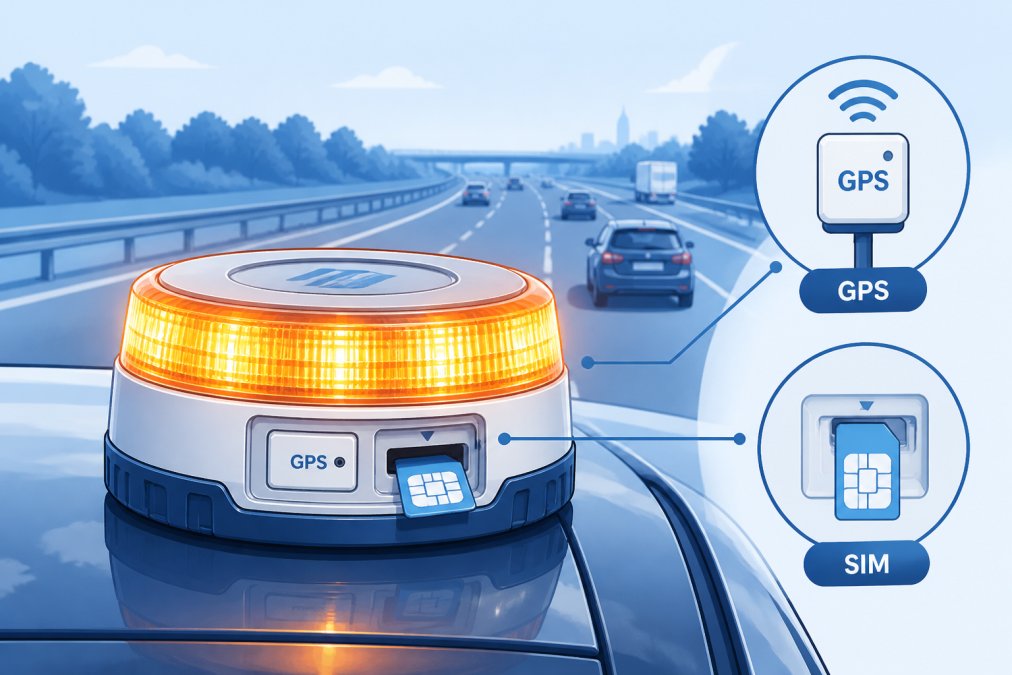
The V-16 beacon operates on a dual-layer connectivity system: GPS for location tracking and a dedicated SIM card for data transmission. When your vehicle stops unexpectedly or you manually activate the beacon, the GPS module acquires your coordinates within 10-15 seconds. Simultaneously, the SIM card establishes a connection to the DGT 3.0 cloud platform and transmits your location, vehicle identification, and incident status.
The SIM card is a machine-to-machine (M2M) SIM issued by Spanish telecommunications providers specifically for IoT devices. The beacon automatically connects to the strongest available cellular network, ensuring connectivity even in areas with weak single-network coverage. The SIM card includes a pre-loaded data plan managed by the DGT, so you do not pay per transmission.
Autonomous operation and cloud-based data transmission
You do not need to manually activate the beacon in most scenarios. The device detects sudden deceleration or impact and automatically initiates transmission. Once activated, the beacon enters autonomous operation mode, continuing to transmit your location every 30 seconds for up to 4 hours. The cloud-based transmission means the beacon does not store data locally, every transmission is sent directly to the DGT 3.0 platform in real time. The cloud platform integrates with Spanish emergency services (112) and motorway management operators, automatically alerting the nearest emergency response unit.
Installation and Placement on Your Vehicle
Roof mounting requirements and positioning for maximum visibility
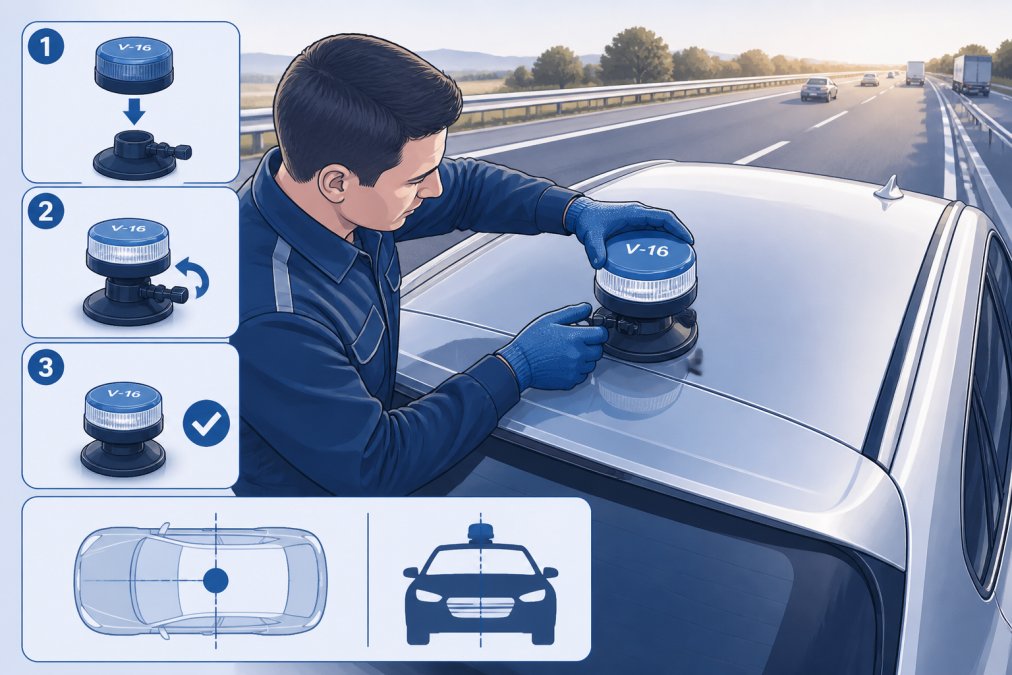
The beacon must be mounted on the roof of your vehicle, not on the bonnet, boot, or window. The ideal mounting location is the centre-rear of the roof, approximately 10-15 centimetres from the rear edge. Most DGT 3.0 beacons use either a suction cup mount or a magnetic base for non-permanent installation.
Clean the roof surface with a damp cloth before installation. Dust or debris prevents the cup from sealing properly. For vehicles with roof racks or caravans, position the beacon forward of these fixtures to ensure unobstructed visibility. The beacon’s GPS antenna must have a clear view of the sky. Once mounted, the beacon should be secure enough to withstand 120 km/h motorway speeds.
Battery Maintenance and Longevity
Checking battery status and extending operational life
DGT 3.0 beacons are powered by rechargeable lithium-polymer batteries, typically rated for 4-6 hours of continuous operation. The battery status is indicated by an LED light: green for fully charged, amber for medium charge, and red for low charge.
Check the battery status weekly, even if you haven’t used the beacon. Recharge the beacon every 2-4 weeks, regardless of usage. Most beacons charge via USB-C or micro-USB ports in 2-4 hours. To extend battery lifespan (typically 3-5 years), charge when it reaches 20% capacity and disconnect at 80% capacity.
Temperature affects battery performance. Cold temperatures reduce battery capacity temporarily; a beacon at 0°C may deliver only 60% of its normal runtime. Store the beacon in a cool location when not in use.
Set a calendar reminder for every 3 weeks to check and recharge your beacon. A dead beacon is useless in an emergency.
Seasonal preparation and storage best practices
Before the summer driving season, test your beacon’s full functionality. Activate it manually, verify that the light flashes correctly, and confirm that GPS and SIM card establish a connection. In winter, store the beacon indoors when not in use. Leaving it mounted on the roof exposes the battery and electronics to freezing temperatures, condensation, and salt spray.
Before reinstalling in spring, inspect the suction cup or magnetic base for cracks or wear. Clean the roof surface thoroughly to remove winter salt residue. If storing for extended periods (more than 3 months), charge to 50% capacity before storage.
Troubleshooting Connectivity Issues and Common Problems
Diagnosing SIM card and network failures
A beacon that won’t connect to the DGT 3.0 platform is useless in an emergency. The most common cause is SIM card failure or network deregistration. If your beacon’s status LED does not show a connected state, verify that the beacon has sufficient battery charge first.
Check that the SIM card is properly seated in its slot. Gently remove and reinsert it, ensuring it clicks into place. If the SIM card is properly seated but the beacon still won’t connect, the SIM itself may be faulty. Contact your beacon supplier to request a replacement SIM card at no additional cost.
Resolving geolocation and data transmission errors
A beacon that connects to the network but fails to transmit your location may have a GPS issue. The GPS antenna requires a clear view of the sky. If your beacon is mounted under a roof rack, caravan, or heavy cargo, the antenna may be blocked.
Test GPS connectivity by activating the beacon in an open area and checking the status LED. If GPS fails in an open area, the antenna may be damaged. Inspect the antenna for cracks or bending. If damaged, contact your supplier for a replacement beacon.
International Drivers and UK-Registered Vehicles in Spain
Compliance requirements for visiting drivers
If you’re driving a UK-registered vehicle into Spain, the DGT 3.0 requirement applies from January 1, 2026, onwards. Spanish traffic law applies to all vehicles operating on Spanish roads, regardless of origin.
Several options exist for obtaining a beacon: purchase in Spain before you travel, rent from a UK car rental company, or purchase from UK suppliers like Roadflash who stock DGT 3.0 devices fully certified for Spanish use.
If you’re driving to Spain regularly, purchasing a beacon is more economical than renting. A beacon costs roughly the same as 4-6 days of rental fees and lasts 3-5 years.
Do not attempt to use warning triangles in Spain from January 1, 2026. Spanish traffic police will fine you for non-compliance regardless of your vehicle’s registration.
Protecting yourself during a motorway breakdown requires more than hope and a mobile phone. DGT 3.0 compliant beacons for Spain provide autonomous, real-time communication with emergency services, eliminating delays and uncertainties of manual reporting. Roadflash’s multi-award-winning emergency beacons deliver full LCOE and IDIADA certification, GPS geolocation, and 360-degree visibility in a single integrated device. With battery life exceeding 4 hours and cloud-based data transmission, these beacons ensure that authorities know exactly where you are the moment your vehicle stops. Add a Roadflash beacon to your vehicle today and drive with the confidence that help is already on the way.
Key Takeaways
| Topic | Essential Information |
|---|---|
| Mandatory date | January 1, 2026, no exemptions or grace period |
| Legal requirement | DGT 3.0 compliant beacon mandatory for all vehicles in Spain |
| Penalty for non-compliance | €200-€500 fine for individuals; €600+ for commercial drivers |
| Visibility range | 360-degree coverage visible up to 600+ metres in daylight |
| Battery life | 4-6 hours continuous operation per charge; recharge every 2-4 weeks |
| GPS accuracy | Typically within 10 metres; requires clear sky view for satellites |
| SIM connectivity | Automatic network registration; requires no manual activation |
| Mounting location | Centre-rear of vehicle roof for optimal visibility |
| Temperature range | Operates -10°C to +60°C; store indoors in winter |
| Certification required | LCOE and IDIADA marks mandatory; verify before purchase |
Frequently Asked Questions
Do I need a DGT 3.0 compliant beacon if I drive a UK-registered car in Spain?
Yes. From January 1, 2026, any vehicle stationary on Spanish roads must display a DGT 3.0 compliant beacon. This applies to visiting drivers with UK-registered vehicles. You cannot rely on traditional warning triangles alone. UK drivers must carry the appropriate connected hazard warning device or face penalties during roadside inspections. Check your vehicle's documentation to confirm compliance before travelling.
What is the difference between a standard V-16 beacon and a DGT 3.0 connected beacon?
Standard V-16 beacons are passive warning lights that flash to alert other drivers. DGT 3.0 connected beacons add geolocation technology, SIM card integration, and real-time incident reporting to the DGT 3.0 platform. Connected beacons automatically transmit your location to emergency services and traffic management systems, enabling faster response times. They operate autonomously without driver intervention and comply with data privacy regulations through anonymous data transmission.
How do I know if my V-16 beacon is DGT 3.0 approved?
Check for LCOE or IDIADA certification codes on the device documentation and packaging. These regulatory approval codes confirm compliance with Spanish traffic authority standards. Look for the certification mark on the beacon itself, usually displayed on the base or back panel. Verify the product has undergone DGT 3.0 platform testing and meets IP54 protection rating requirements. Request certification documentation from your supplier before purchase to guarantee compliance.
What happens if I don't install a DGT 3.0 compliant beacon by January 1, 2026?
From January 1, 2026, driving without a DGT 3.0 compliant beacon on Spanish roads is illegal. Traffic officers conducting roadside inspections can issue fines and penalties. Non-compliance also affects insurance claims if you're involved in an accident while stationary on a motorway or highway. The mandatory implementation date applies to all vehicles, regardless of registration country, making compliance essential for any driver using Spanish roads.
Can I still use traditional warning triangles instead of DGT 3.0 beacons?
No. DGT 3.0 compliant beacons replace traditional warning triangles as mandatory equipment from January 1, 2026. While you may keep old triangles for reference, they no longer meet legal requirements on Spanish roads. The connected beacon's geolocation and real-time reporting capabilities provide significantly better protection than passive triangles, which is why the transition is mandatory. You must dispose of old triangles responsibly and upgrade to approved connected equipment.
How does the geolocation and SIM technology work in DGT 3.0 beacons?
DGT 3.0 beacons contain a SIM card that connects to mobile networks to transmit your vehicle's GPS location to the DGT 3.0 cloud-based platform. When activated during a breakdown, the beacon automatically sends incident data including your precise coordinates, vehicle information, and timestamp. Emergency services and traffic management systems receive this data in real-time, enabling faster response and better traffic flow management. The system operates autonomously without requiring driver input after initial activation.
What should I do if my DGT 3.0 beacon loses connectivity?
First, check that the SIM card is active and your vehicle is in an area with mobile network coverage. Restart the beacon by removing and reinserting the battery, waiting 30 seconds before reactivating. Verify the SIM card contacts are clean and properly seated. If connectivity issues persist, contact your supplier for SIM card replacement or technical support. Keep spare batteries available during long journeys. Document any persistent failures and report them to ensure emergency response capability remains functional.
External Resources
For official guidance on DGT 3.0 requirements and specifications, consult [EXTERNAL_LINK: Dirección General de Tráfico (DGT) official regulations | dgt.es].
For technical certification details and testing standards, review [EXTERNAL_LINK: IDIADA automotive safety testing protocols | idiada.com].
For purchasing guidance and compliance verification, contact [EXTERNAL_LINK: Roadflash DGT 3.0 beacon certification database | roadflash.com].
This article was written using GrandRanker