

How to Stay Safe During a Motorway Breakdown: 2026 Guide
Table of Contents
- Motorway Breakdown Safety: What to Do in the First 60 Seconds
- Smart Motorway Breakdown Rules UK: No Hard Shoulder, No Problem
- Motorway Emergency Refuge Area: How to Find and Use One
- Calling for Help: 999, Traffic Officers, and Breakdown Cover
- Motorway Breakdown Kit: What Every Driver Should Carry
- Motorway Breakdown Safety for Vulnerable Road Users
- Your Motorway Breakdown Checklist UK: Step-by-Step Summary
- Common Bad Advice About Motorway Breakdowns (And What to Do Instead)
Last Updated: July 30, 2026
Motorway breakdowns cause serious casualties every year, many preventable. This guide covers every scenario from a tyre blow-out to complete engine failure, showing exactly what to do, what most guides get wrong, and how the right equipment saves lives. The uncomfortable truth: hazard lights alone are not enough. At motorway speeds, approaching drivers have only seconds to react. Visibility, positioning, and your first 60 seconds determine your safety.
Motorway Breakdown Safety: What to Do in the First 60 Seconds
Your first priority is reaching a place of relative safety as quickly as possible. Every second in a live lane increases your exposure to fast-moving traffic.
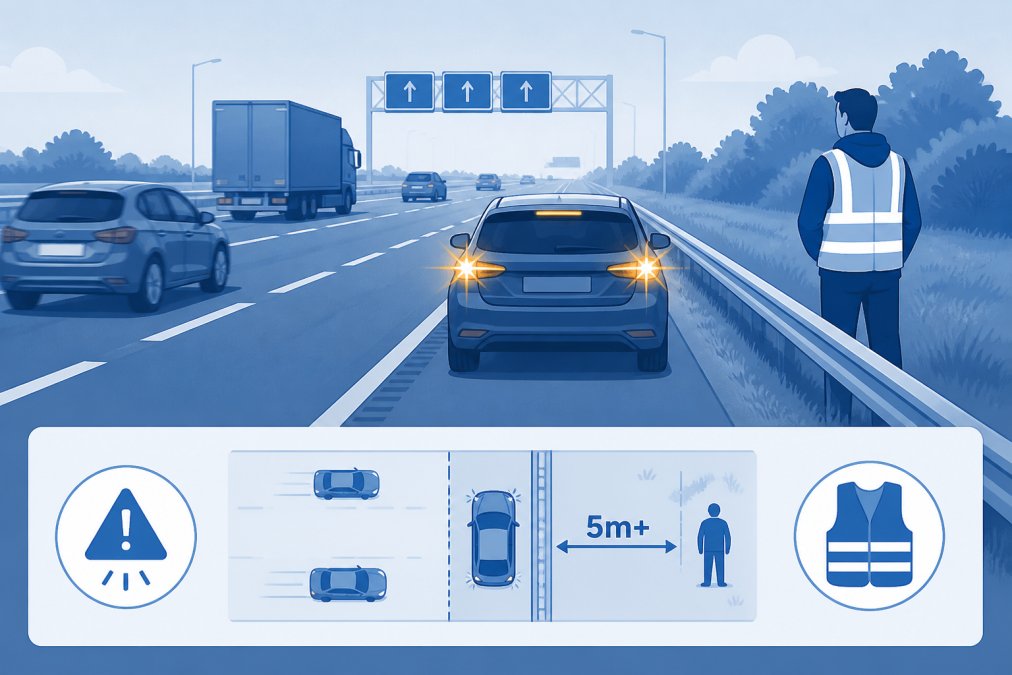
Here is the correct sequence:
- Signal left immediately and move towards the hard shoulder or nearest emergency refuge area.
- Activate your hazard lights as soon as you recognise a problem.
- Steer to the far left, positioning your vehicle close to the nearside barrier or verge.
- Apply the handbrake firmly to prevent rolling.
- Turn your wheels to the left. If struck from behind, turned wheels direct the car away from traffic.
- Switch on your sidelights for poor visibility.
(/optimising-roadside-visibility-a-professional-guide-to-breakdown-safety/): What to Do in the First 60 Seconds]
Once you exit, the steering column will lock if you remove the key, correct procedure. If a passenger remains inside, ensure they understand not to attempt moving the vehicle without you.
Using Your Hazard Lights and Positioning Your Vehicle
Switch hazard lights on the moment you suspect a problem, not after stopping. According to The Highway Code Rule 274 guidance on GOV.UK, you must use hazard warning lights when your vehicle is stationary and causing an obstruction.
Position your vehicle as far left as possible, leaving maximum distance between it and live lanes. Aim for a point near an emergency telephone, spaced at roughly one-mile intervals. Angle the front slightly towards the verge rather than stopping parallel to the live lane, this creates a physical buffer and signals to approaching drivers that your vehicle is not moving.
How to Exit Your Vehicle Safely
Exit through the passenger or rear passenger door on the nearside, never the driver’s side. Move everyone away from the vehicle, up the embankment or behind the barrier. Do not stand between your vehicle and the barrier; stand beyond it. Keep away from the rear, rear-end impacts are the most common hard shoulder collision type. Keep high-visibility clothing on at all times.
Do not let children or pets run freely on the verge. Keep them close and seated on the grass bank, away from the carriageway edge.
Never stand behind your vehicle to wave down traffic or retrieve items from the boot. Rear-end collisions on the hard shoulder are disproportionately severe because approaching vehicles are still travelling at motorway speed.
Smart Motorway Breakdown Rules UK: No Hard Shoulder, No Problem
Smart motorways convert the hard shoulder into a running lane during peak periods, meaning there is no permanent refuge at the road edge. Smart motorway breakdown rules differ fundamentally from conventional motorway guidance.
According to National Highways smart motorway safety information, all-lane running motorways have emergency refuge areas at intervals of no more than 1.5 miles.
If you break down on a smart motorway:
- Try to reach the nearest emergency refuge area, marked with blue signs featuring an orange SOS telephone symbol.
- If you cannot reach one, pull as far left as possible and stop.
- Switch on hazard lights immediately.
- If a red X signal appears above your lane, traffic should not enter it, the system is protecting you.
- Call 999 or use the SOS phone in the refuge area. Traffic officers can activate overhead signals to close the lane around your vehicle.
What to Do If You Break Down in a Live Lane
Breaking down in a live lane is the most dangerous scenario. The priority is to exit the vehicle and get behind the barrier immediately.
Do not remain in the vehicle. A stationary vehicle in a live lane is an extreme collision risk. Exit via the nearside, move behind the barrier, and call 999 immediately. Do not attempt to push the vehicle or stand in front of or behind it. Traffic officers have authority and equipment to manage vehicle recovery in live lanes, and emergency services can close lanes overhead on smart motorways.
If your vehicle has a connected emergency call system, it will often transmit your GPS location automatically to emergency services. Check your vehicle handbook before you need it.
Motorway Emergency Refuge Area: How to Find and Use One
A motorway emergency refuge area is a dedicated lay-by on a smart motorway, separated from running lanes by a raised kerb, designed specifically for broken-down vehicles.
How to identify an emergency refuge area:
- Blue background sign with an orange SOS telephone symbol
- White painted bay with hatched entry section
- Orange SOS telephone mounted on a post inside the bay
Once inside, apply the handbrake, switch on hazard lights, and exit via the nearside door. Use the SOS telephone to contact Highways England traffic officers directly. These phones connect you to a control room that can see your location via CCTV and activate overhead lane signals to warn approaching traffic.
You cannot use a refuge area as a rest stop. Stopping for any reason other than a genuine emergency or breakdown is an offence under motorway regulations.
Calling for Help: 999, Traffic Officers, and Breakdown Cover
Once safe, call for assistance through one of three channels:
- 999: Call if there is any risk to life, if someone is injured, or if your vehicle is in a live lane. Emergency services can coordinate with National Highways to close lanes.
- Highways England Traffic Officers: Reachable via SOS phones on the hard shoulder or in emergency refuge areas. Traffic officers manage motorway incidents and assist with vehicle recovery.
- Your breakdown cover provider: Call once in a safe location. Give your exact location using motorway junction numbers, direction of travel, and visible marker post numbers.
Marker posts are small blue posts at the roadside, numbered at 100-metre intervals. Quoting the nearest number gives your recovery service your precise location, especially useful on long stretches between junctions.
If injured or disoriented, GPS-enabled emergency equipment becomes genuinely valuable. Roadflash’s early warning beacons include GPS/geolocation functionality, meaning your precise position can be communicated even when you cannot describe your location accurately.
Motorway Breakdown Kit: What Every Driver Should Carry
Your motorway breakdown kit determines how visible and protected you are in critical minutes before help arrives.
| Item | Purpose | Priority |
|---|---|---|
| High-visibility vest | Ensures you are seen by passing traffic | Essential |
| Warning triangle | Alerts approaching drivers to hazard | Essential |
| Active LED warning beacon | Dynamic, high-visibility alert at motorway speeds | Strongly recommended |
| Torch | Visibility in darkness or poor weather | Essential |
| First aid kit | Immediate response to injuries | Essential |
| Warm clothing or blanket | Protection during long waits in cold weather | Recommended |
| Phone charger or power bank | Maintaining communication with services | Recommended |
| Breakdown cover details | Contact number and policy reference | Essential |
The difference between a reflective triangle and an active LED beacon is significant at speed. A static reflector depends entirely on another vehicle’s headlights to be visible. An active beacon generates its own light, making it effective in daylight, poor weather, and at greater distances. This is the core problem Roadflash’s multi-award-winning early warning systems solve: stationary vehicles on motorways are hardest to see precisely when they are most dangerous.
Your motorway breakdown kit should include at least one active light source beyond your vehicle’s own hazard lights. Passive reflectors depend on other drivers’ headlights, which is a significant limitation in daylight or adverse weather.
Motorway Breakdown Safety for Vulnerable Road Users
Standard breakdown advice assumes a single adult driver in reasonable physical condition. Real journeys are rarely that simple.
Managing Panic and Staying Calm Under Pressure
Panic is the single biggest threat to good decision-making during a breakdown. Drivers who have thought through breakdown scenarios in advance make faster, better decisions under pressure. Run through the sequence before you need it: signal, move left, stop, hazard lights, exit nearside, barrier, call.
If you feel overwhelmed after stopping safely, take 30 seconds before making calls. Breathe, orient yourself, locate the nearest marker post number, then act. Calling 999 with a clear head produces more useful location information than calling in panic.
Travelling with Children, Older Passengers, or Pets
Children should exit with you and be held or seated on the grass bank, away from the carriageway edge. Do not leave children in the vehicle. A rear-end collision at motorway speed makes the inside of a stationary vehicle extremely dangerous.
Older passengers or those with limited mobility need assistance exiting via the nearside. If a passenger cannot exit, move them to the front passenger seat and ensure they wear a seat belt. Call 999 and explain the situation.
Pets should be secured on a lead before exiting. Keep them close and low on the verge. As documented in [road safety(/roadflash-wins-2024-road-safety-specialist-of-the-year-award/) guidance for vulnerable road users from the Royal Society for the Prevention of Accidents | rospa.com], passengers with disabilities require specific consideration in emergency planning.
Your Motorway Breakdown Checklist UK: Step-by-Step Summary
Before you travel:
- Check tyre pressure, tread depth, and fuel level
- Confirm breakdown cover is active and the number is saved in your phone
- Pack a high-visibility vest, torch, and active warning beacon
- Charge your phone or carry a power bank
At the moment of breakdown:
- Signal left and activate hazard lights immediately
- Steer to the hard shoulder or emergency refuge area
- Apply the handbrake and turn wheels to the left
- Exit via the nearside door
- Move all passengers behind the barrier or up the verge
- Note the nearest marker post number
Once safe:
- Call 999 if anyone is injured or the vehicle is in a live lane
- Call your breakdown cover provider with your location
- Deploy your warning beacon or triangle behind the vehicle
- Stay behind the barrier and wait for assistance
- Do not attempt to repair the vehicle on the motorway
After recovery:
- Arrange onward transport or a recovery vehicle to a safe location
- Have the vehicle inspected before returning to motorway driving
- Report any road defects or hazards to National Highways
Common Bad Advice About Motorway Breakdowns (And What to Do Instead)
Some widely repeated breakdown advice is outdated or dangerous.
Bad advice: "Stay in your vehicle, it’s the safest place."
This guidance has been revised. On a smart motorway with no hard shoulder, remaining in a stationary vehicle in a live lane is extremely dangerous. Current guidance from National Highways and The Highway Code is to exit the vehicle and get behind the barrier when safe.
Bad advice: "Put your warning triangle 45 metres behind the vehicle."
This is correct for the hard shoulder but prohibited on smart motorways. Placing a triangle in a live lane to walk back to your vehicle puts you at severe risk. Rely on hazard lights and call for help immediately.
Bad advice: "Your hazard lights are enough."
Hazard lights are essential but insufficient at motorway speeds, particularly in daylight or heavy rain when amber indicators are difficult to distinguish. An active beacon generating high-intensity light at a higher angle provides significantly greater visibility.
Bad advice: "Wait until you’ve fully broken down before pulling over."
The moment you notice unusual engine behaviour, tyre handling changes, or warning lights, begin moving left. Early action gives you more options and often means stopping in a better position.
The pattern is consistent: the most dangerous situations involve delayed action, staying in the vehicle too long, or relying on passive safety measures. Proactive positioning, active warning systems, and immediate communication with emergency services save lives.
Staying safe on a motorway after a breakdown requires the right equipment, a clear plan, and the confidence to act quickly. Passive reflectors and hazard lights alone leave a significant visibility gap at motorway speeds and in adverse conditions. Roadflash’s multi-award-winning early warning systems, including GPS/geolocation-enabled beacons with high-visibility lighting, are designed specifically for this scenario: making stationary vehicles visible to approaching traffic before it is too late. Visit the Roadflash website to view the full product range and add to basket today.
Frequently Asked Questions
What should you do immediately after breaking down on a motorway in the UK?
As soon as you feel your vehicle losing power, signal left and move to the hard shoulder or the nearest emergency refuge area if you are on a smart motorway. Switch on your hazard lights immediately. Apply the handbrake, turn your wheels towards the verge, and exit via the left-hand door away from traffic. Move behind the barrier if one is present, stay well clear of the live lanes, and call 999 or your breakdown cover provider. Motorway breakdown safety depends on acting quickly and calmly.
Is it safer to stay in your car or get out during a motorway breakdown?
On a conventional motorway with a hard shoulder, The Highway Code advises you to get out of the vehicle and wait behind the safety barrier, away from traffic. Staying inside a stationary car on or near a live lane puts you at serious risk if another vehicle strikes yours. However, if you cannot exit safely, for example on a busy smart motorway live lane, staying inside with your seat belt fastened and calling 999 immediately may be the safer short-term option until traffic officers or police arrive.
What should you do if you break down on a smart motorway with no hard shoulder?
Follow smart motorway breakdown rules UK guidance: aim for an emergency refuge area (ERA), identifiable by blue signs with an orange SOS telephone symbol. If your vehicle becomes immobilised in a live lane, switch on hazard lights, call 999, and keep your seat belt on. National Highways' technology monitors stopped vehicles via CCTV and overhead gantry signs. Traffic officers can close the lane, but you must alert emergency services immediately, do not assume the system will detect you automatically.
What essential items should you keep in a motorway breakdown kit?
A well-stocked motorway breakdown kit should include a high-visibility vest for every passenger, a warning device such as an advanced early warning beacon, a fully charged mobile phone or portable charger, a torch, a first-aid kit, a warm blanket, and your breakdown cover membership details. The Highway Code does not legally require a warning triangle on UK roads, but a visible, active warning device significantly improves your safety by alerting approaching drivers well before they reach your stationary vehicle.
Can you be fined for stopping on the hard shoulder of a motorway?
Yes. Under motorway regulations, stopping on the hard shoulder is only permitted in a genuine emergency or breakdown. Using it for rest breaks, checking a map, or making a phone call is illegal and can result in a fixed penalty notice or prosecution. On smart motorways where the hard shoulder has been converted to a running lane, stopping there outside of a genuine emergency is particularly dangerous and is treated as a serious offence by both police and National Highways traffic officers.
How do you contact emergency services or breakdown recovery on a motorway?
Call 999 if you or anyone is in immediate danger or if your vehicle is in a live lane. For non-life-threatening breakdowns, call your breakdown cover provider directly. On older motorway sections, orange SOS emergency telephones are located every mile on the hard shoulder, they connect directly to National Highways and automatically relay your location, which is particularly useful if you are unsure of your position. Always state your location, the number of passengers, and any vulnerability factors when you call.
What are the rules for passengers during a motorway breakdown?
All passengers should exit the vehicle via the left-hand doors as soon as it is safe to do so, moving well away from the carriageway and behind any available barrier. Children should be helped out immediately and kept close. Everyone should put on high-visibility clothing from your motorway breakdown kit. Passengers must not stand near the rear of the vehicle or wander towards the live lanes. If exiting is unsafe, for instance when stopped in a live lane, all passengers should keep their seat belts fastened and await emergency services.
This article was written using GrandRanker